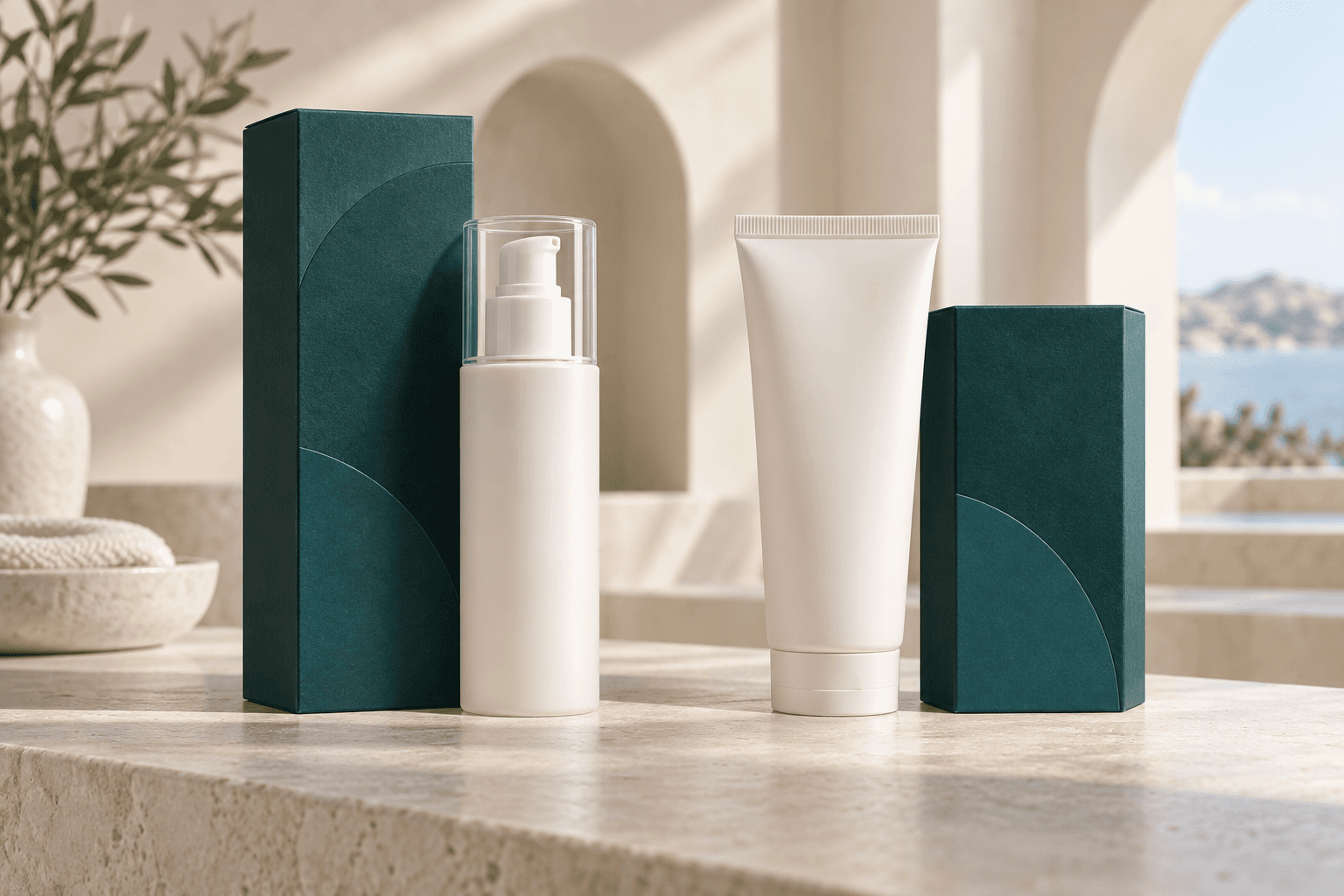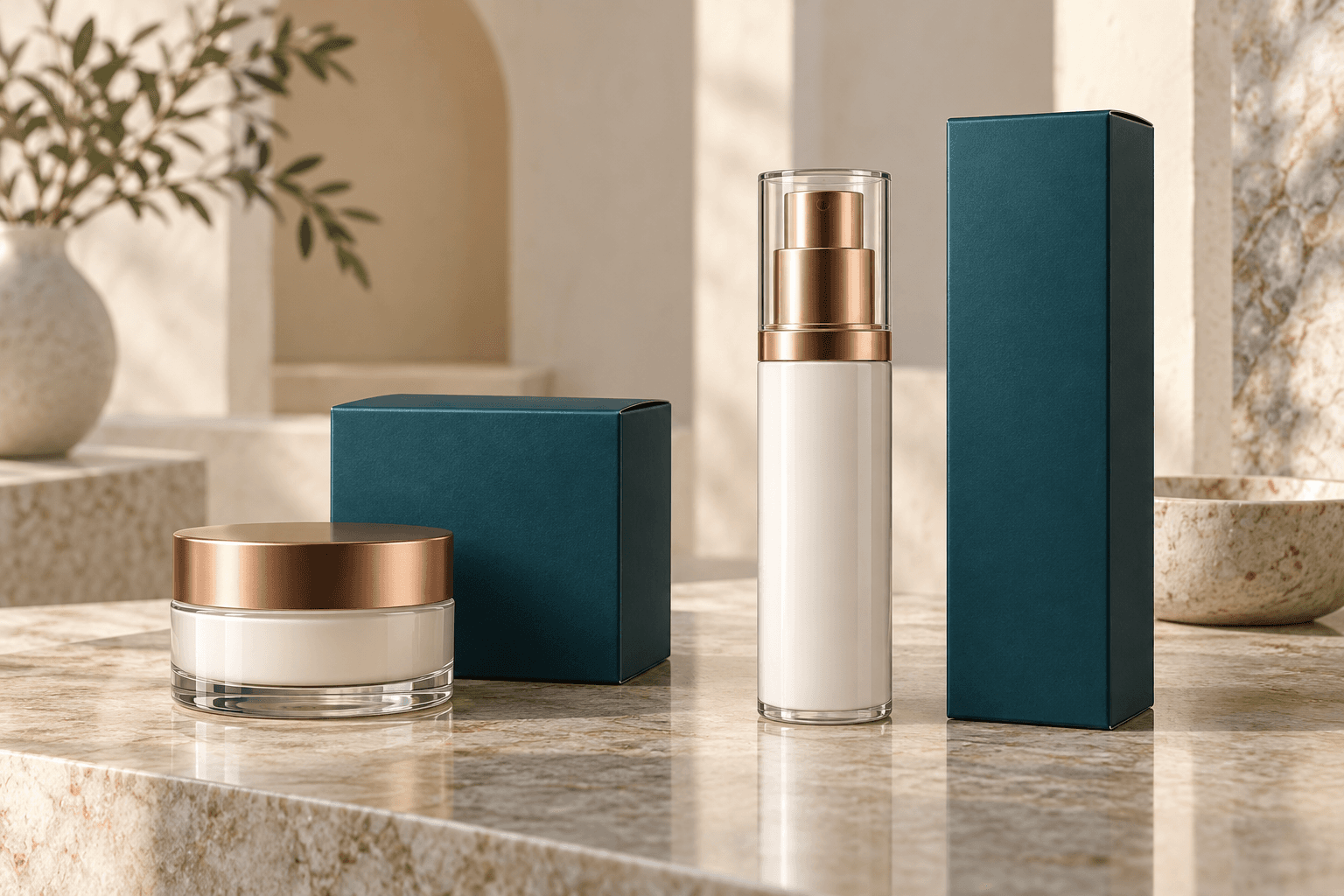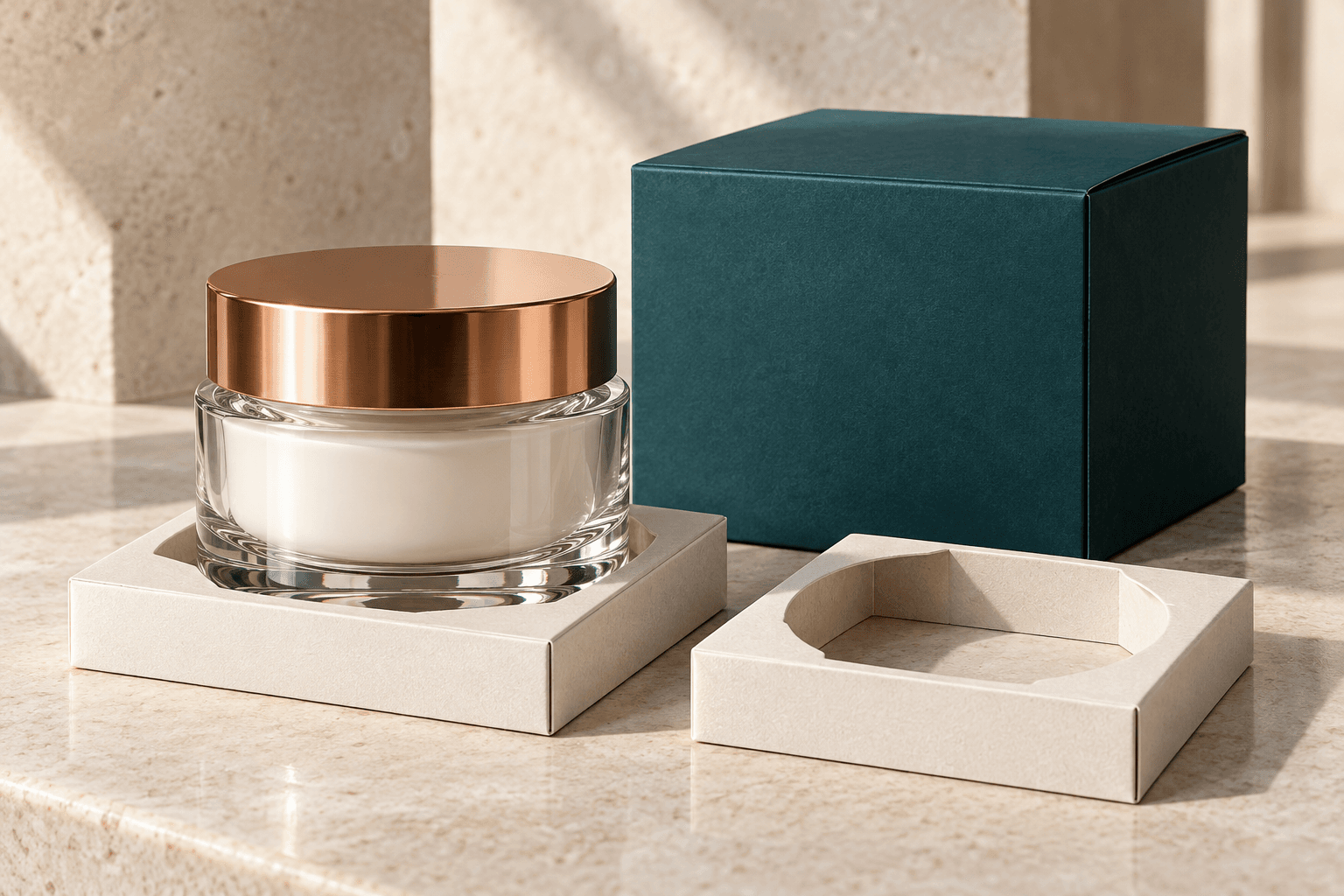

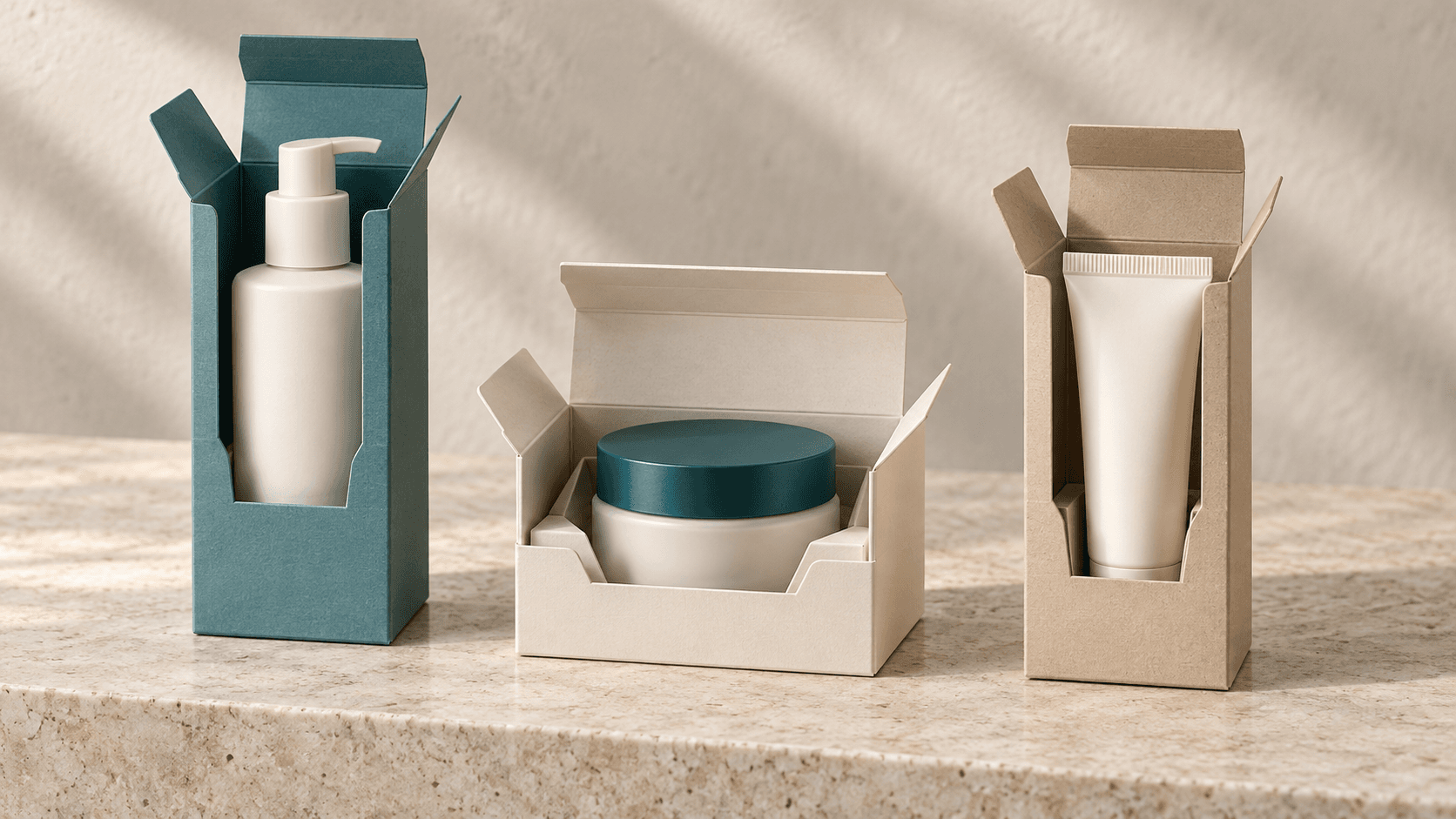
Choose outer packaging for skincare bottles, jars and tubes by comparing their finished shape, filled weight, closure and loading behavior—not just their product category or volume. Bottles can need support around a narrow body and projecting dispenser; jars require attention to lid width and concentrated weight; flexible tubes need space for the sealed tail without being squeezed. The carton and any insert should respond to those differences.
This skincare packaging guide concerns secondary packaging: the retail box or presentation structure surrounding an already selected skincare container. It does not select a container for formula compatibility or replace the brand’s product-safety work. PearlFold’s skincare packaging category remains the place to explore commercial options for the individual products.
Separate container selection from carton selection
The primary container holds the formula. The outer carton presents information, organizes the retail unit and contributes to the handling system. A change to the bottle, pump, jar lid or tube closure can affect both, but an attractive carton cannot correct a leaking or incompatible primary package.
For example, Richmond’s container-and-closure guidance explains why nominal thread information alone does not replace compatibility review. Finalize the relevant container assembly with the qualified product and filling teams, then give the carton designer its controlled dimensions and samples. Keep any provisional choice clearly marked.
Do not use the formula name as the entire structural brief. “Moisturizer” might mean a low glass jar, an airless bottle or a squeeze tube. Each creates a different footprint and packing task, even when the brand wants the same shelf identity.
Skincare packaging guide: compare the three formats
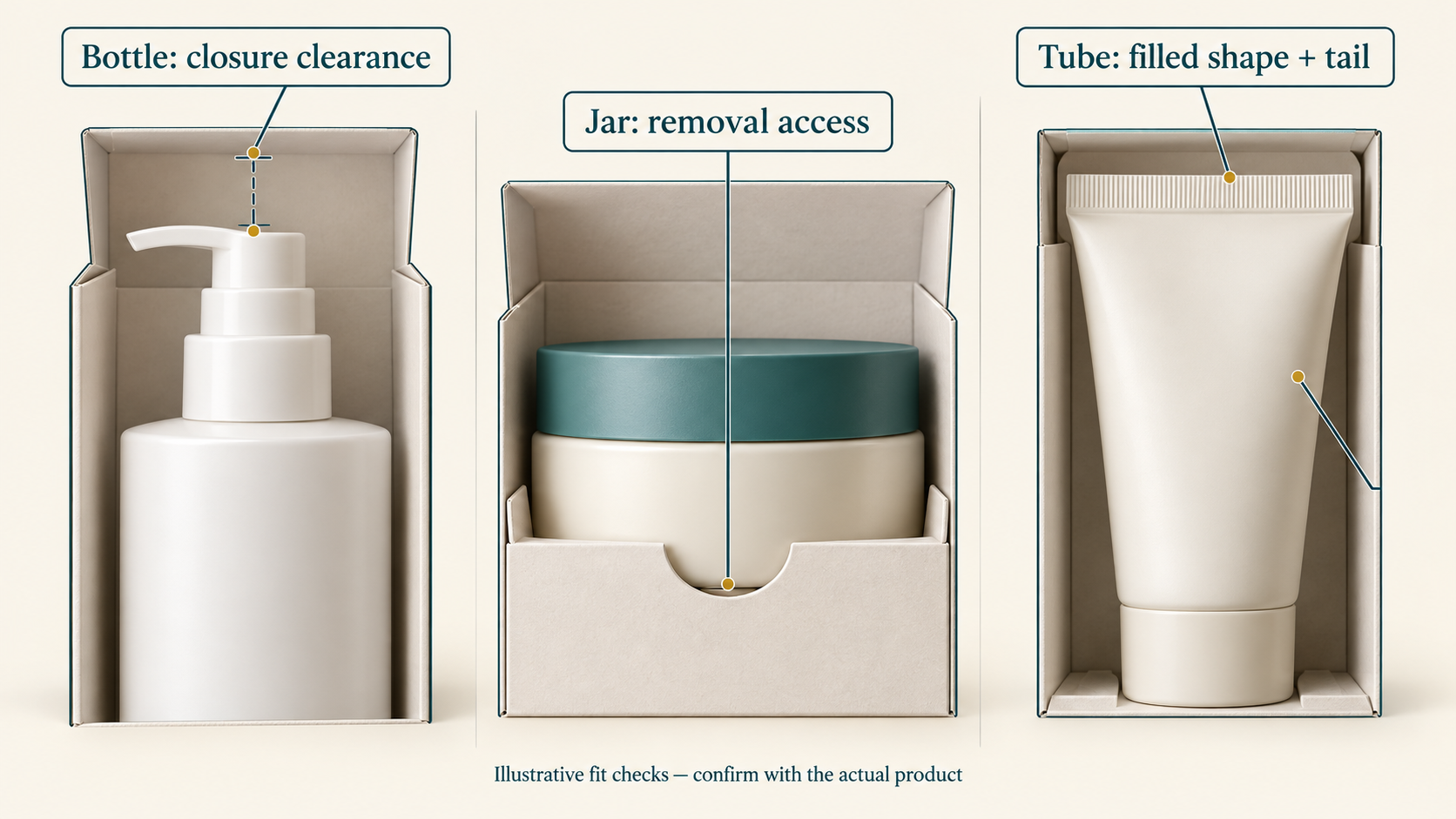
| Format | Fit priority | Common review concern | Useful sample check |
|---|---|---|---|
| Bottle | Full height, widest shoulder and fitted closure | Rotation, movement or pressure on a dispenser | Load, close and remove without actuating or pulling the closure |
| Jar | Maximum lid diameter, body depth and filled weight | Excess void, unsupported weight or difficult grip | Lift the jar without trapping fingers or disturbing the insert |
| Tube | Filled profile, cap and sealed tail | Compression, tail interference or unstable presentation | Check the whole tube in its actual filled and closed condition |
The table identifies questions rather than prescribing an insert for every item. A simple carton may be sufficient for one product, while another needs a platform, collar or more developed support. Decide from the specific product and its route to the customer.
Bottles: give the closure space without leaving the body loose
A narrow bottle with a wide pump or dropper can create an awkward envelope. Sizing the whole carton to the closure may leave room for the body to move. Sizing it only to the body may prevent loading or place pressure on the dispenser. Record the maximum dimensions of both parts and show the transition at the shoulder.
Consider how the product enters the package. A top-loaded bottle must pass through the opening with the production closure fitted unless the agreed packing process says otherwise. If an internal collar is used, its assembly and removal path need to be understood before approving a seemingly neat drawing.
Do not use a pump head as an assumed support surface. Confirm its locked or shipping condition with the container supplier, and check that the closed carton does not actuate it. For dropper formats, review the bulb, collar and cap rather than assuming every component tolerates the same contact.
Artwork can also help keep bottle variants distinct. A shared outer structure may be practical when the complete assemblies match, but separate barcode and product-copy checks are still necessary. See the serum box options when the specific product is a serum rather than treating this format comparison as a replacement product page.
Jars: control footprint and make removal comfortable
A jar’s lid may be wider than its body, and a rounded shoulder can sit below that lid. Measure both. A cavity based only on body diameter can obstruct loading; one based only on the largest diameter may not provide the intended restraint lower down.
Filled weight belongs in the brief. A compact glass jar can place a meaningful load on a relatively small base area. The designer needs to consider how that load is supported by the chosen carton and insert, rather than selecting board from the product’s short height alone.
A low jar inside a tall box often creates unnecessary empty space. Before adding a decorative platform, ask whether the outer height should be reduced. If extra height has a defined purpose—such as accommodating an applicator—show that component in the layout and include its removal sequence in the review.
Finger access is especially important around broad jars. The user should not have to pry the item out by its lid or shake the box. A shaped opening or another agreed access feature may help, but the real jar should determine whether the solution works. For a cream-specific project, the commercial owner is the face cream boxes page.
Tubes: measure the filled shape and account for the tail
An empty tube can lie flatter than the filled product and may not represent its packed profile. Provide a representative filled, sealed and capped sample. Include the widest body area, cap projection and sealed tail in the dimensional record rather than treating the tube as a perfect cylinder.
The tail can be wider than the main body or catch during loading. Show its position relative to the front artwork and state whether the product stands on its cap or is packed another way. A carton closure that appears clear in a side view can still interfere with the tail across the other axis.
A flexible tube should not be squeezed into a smaller space simply because it can deform. Review pressure, appearance and removal in the actual closed package. Any support feature should be evaluated with the intended tube construction and fill condition, not with an empty photography prop.
Decide whether an insert solves a defined problem
Write the problem before choosing the insert material. Is the bottle rotating, the jar lifting from its seat, or the tube leaning away from its intended presentation? Different problems can require different geometry. Adding a tray without specifying its function may increase assembly without improving the result.
Also check whether the outer carton can be improved first. A better footprint, loading direction or closure may address the problem more simply. If an insert is justified, review it as part of the complete package: its own movement, product contact, assembly, closure clearance and customer access all matter.
Use PearlFold’s insert planning resource for the broader development questions. No material is automatically the most protective or environmentally preferable for every skincare format; the final construction and supporting evidence determine what can be claimed.
Coordinate a range without forcing identical dimensions
A family of skincare products can share typography, color relationships, finish priorities and front-panel hierarchy while using different carton proportions. This is often a better design problem than making a tall pump bottle and a low jar occupy the same outer box.
Illustrative range decision: a serum bottle, cream jar and cleansing tube use one brand mark and the same order of front-panel information. Each receives a format-specific carton and its own fit review. The range stays recognizable through the visual system, while the structure follows the product rather than empty space being added to match the tallest SKU.
Review the assembled cartons together at shelf scale. Check whether the product names remain readable, variants are distinguishable and the opening direction feels consistent where practical. Do not approve each flat artwork file in isolation and assume the range will look coordinated after folding.
Check the complete delivery and packing context
A retail carton is not automatically a shipping package. State whether units travel inside a master carton, a direct-to-consumer shipper or a gift set. The outer distribution configuration can change the protection questions, even when the retail presentation is unchanged.
Before ordering, review how empty cartons and inserts arrive, who assembles them and how products are loaded. Look for steps that require forcing a closure, compressing a tube or gripping a decorated surface. Record the agreed sequence with the structural version.
Keep product, carton and insert samples linked to the same approval record. If the primary container changes later, identify which dimensions, support points and artwork relationships need another review. A shared product name or nominal volume is not enough to authorize the previous box unchanged.
Questions about skincare container formats
Can bottles, jars and tubes use folding cartons?
They can be evaluated for folding-carton packaging, but each needs its own fit and support assessment. Container shape, weight, closure and distribution context determine whether a proposed construction is suitable.
Is a glass jar automatically a rigid-box project?
No. Primary-container material alone does not choose the outer structure. Review weight, protection, presentation and handling together, then assess an appropriate sample of the proposed system.
Should a tube be measured empty?
Not as the sole final reference. An empty tube may have a different profile. Supply the filled, sealed and closed configuration intended for packing and identify any provisional details.
Can a carton prevent a pump from leaking?
Do not rely on it to correct a primary-container problem. Confirm the pump and bottle system with the responsible supplier and product team. The carton should avoid unwanted pressure on the dispenser.
Does every skincare bottle need an insert?
No. Add an insert when it addresses a defined fit, restraint, access or presentation requirement. Evaluate simpler structural solutions as well rather than treating an insert as a premium default.
Why is the lid diameter important for a jar?
The lid can be the widest component and control loading clearance. The body and base still matter for support, so include both the maximum envelope and the profile beneath it.
Should all products in a skincare range have equal-height cartons?
Only if there is a justified requirement and the structures remain practical. Visual consistency can come from artwork and proportions without adding unnecessary space to shorter products.
Can one insert fit several bottle sizes?
Only after every intended version is checked. A larger opening may accommodate one cap while leaving another bottle insufficiently controlled. List the covered product references explicitly.
What if a new closure changes only the height?
Review the top clearance, carton closure and support arrangement again. Even a height-only change can affect packing or pressure inside the box; do not approve it from volume alone.
What information makes a skincare carton inquiry useful?
Provide finished dimensions, filled weight, closure details, photographs, quantity per SKU, artwork status and the sales channel. Identify the main concern, such as movement, removal access or range consistency.
Make the format decision product-specific
Begin with the actual bottle, jar or tube, then choose the outer structure around its behavior. When the product record is ready, send the dimensions and open questions through the custom quote form. Confirm the proposed material, insert, sample scope and production terms in writing rather than treating a general format guide as a finished specification.