

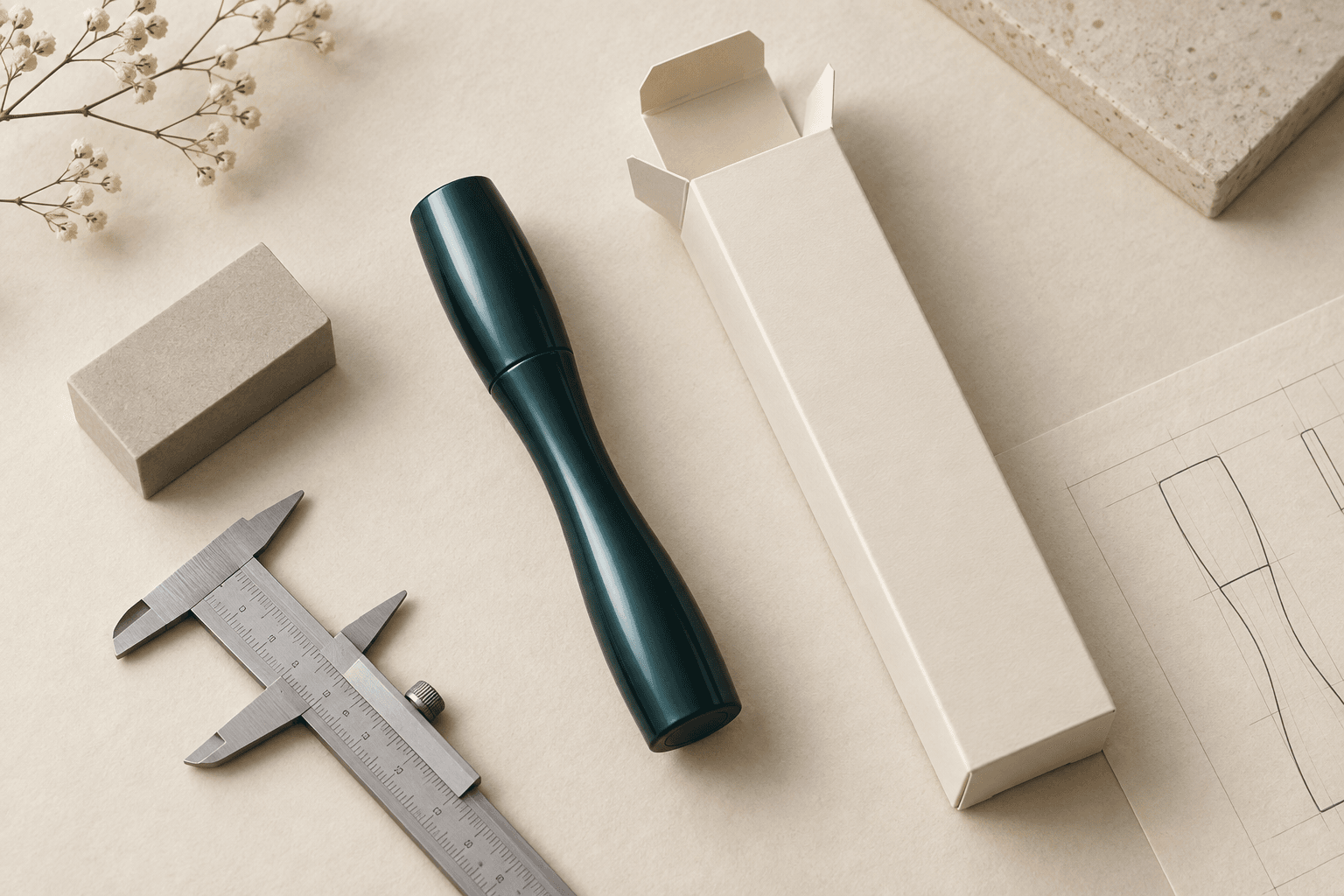
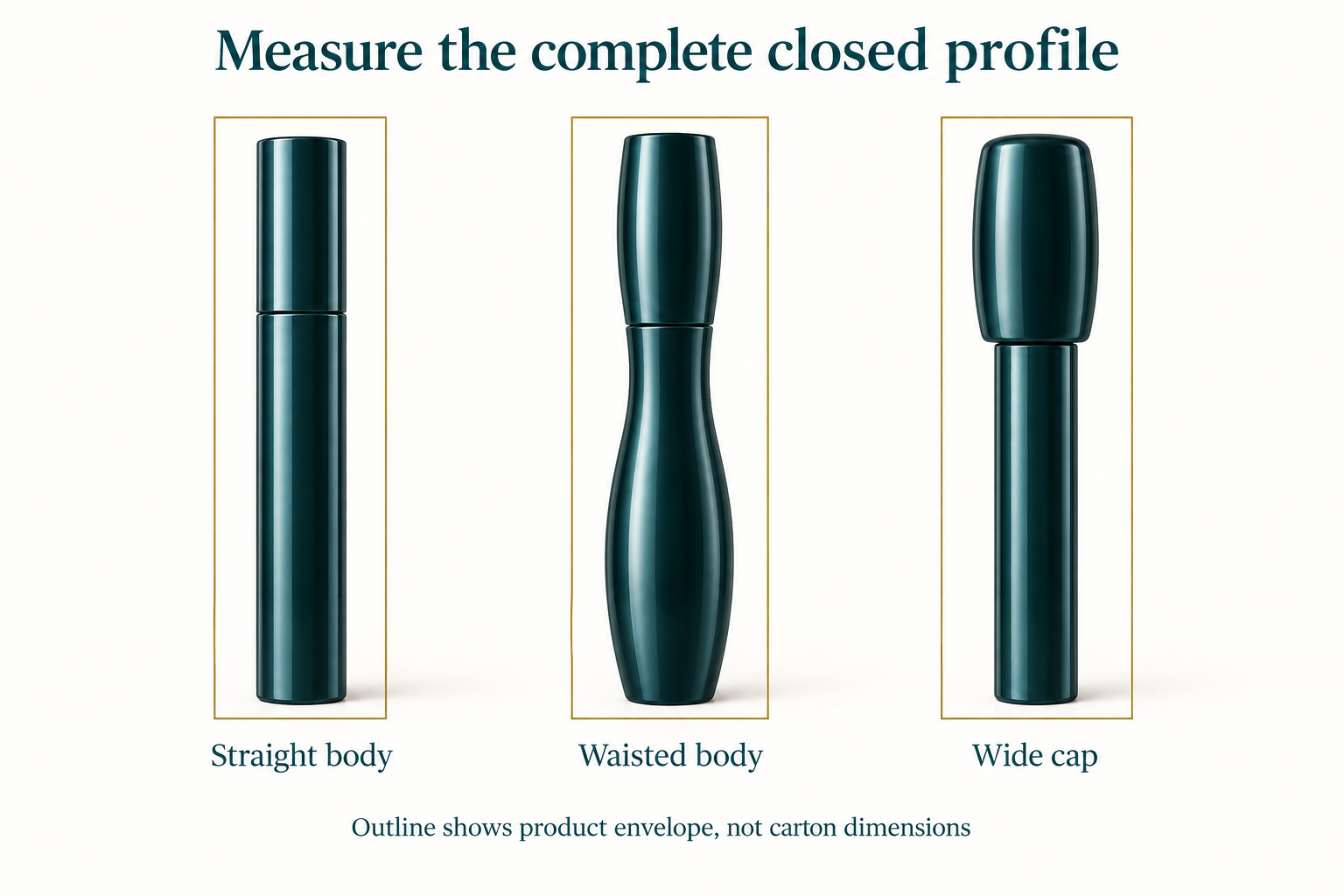
Measure a mascara tube for packaging in its fully closed retail configuration. Record the total height, maximum width and depth, cap profile, shoulder transitions and finished weight. The brush and rod usually sit inside the closed assembly; adding their exposed length to the closed tube height would describe the wrong packaging envelope. A wide cap, curved barrel or decorative collar can matter more to carton fit than the container’s nominal fill volume.
Mascara creates a distinctive fit problem: a long, relatively narrow product can contact a carton at just a few points. A bulbous cap and a slender middle behave differently from a straight cylinder of the same maximum diameter. This guide helps you document those differences, agree the pack-out direction and assess a prototype without inventing a standard clearance that might not work for your product.
Make the retail configuration unambiguous
Begin by identifying the exact bottle, cap and decoration revisions. Assemble the unit according to the primary-packaging supplier’s instructions. The cap should be seated normally, not left loosely engaged to make the product look taller, and not forced beyond its intended closure position. Photograph the joint so reviewers can understand what was measured.
A brush reference or neck designation is not the finished outside dimension. For example, HCP’s 12 mm Hourglass Mascara product sheet lists a 12 mm neck, 17 mm external diameter and 137 mm height. Those three different figures describe different aspects of one product. They are a supplier example, not default dimensions for mascara or a specification for your carton.
If a product includes a separate overcap, tamper feature or promotional attachment, decide whether it is present during boxing. Include every part that belongs to the retail unit. Conversely, do not measure a demonstration sample with an oversized display accessory that will never enter the production carton.
Record the profile, not just height and diameter
Stand the closed tube on a flat surface and measure to its highest point. Then inspect the full length for the largest cross-section. A cap with a rounded crown may set the height; a flared base or shoulder may set the width. Record maximum width and depth independently for oval, flattened or angular packs.
Keep the instrument square to the dimension being checked and avoid marking the product. For a curved barrel, a photograph beside the dimensional record can be more useful than several unlabeled numbers. Describe where each dimension was taken. The designer needs to know whether the widest point is at the loading end, halfway down the body or close to the bottom closure.
| Profile feature | Measurement note | Question for the prototype |
|---|---|---|
| Straight cylindrical body | Maximum outside diameter and closed height | Does the tube rotate or slide more than intended? |
| Hourglass or waisted body | Largest upper and lower sections plus narrow middle | Where does the structure actually contact the product? |
| Oval or flat-sided cap | Separate width, depth and required orientation | Can the cap pass the opening without turning or snagging? |
| Raised collar or band | Projection and position along the tube | Does it catch a flap or rub against a retaining feature? |
| Double-ended assembly | Full closed envelope and both end shapes | Can packing or extraction disturb either closure? |
Record filled weight and the intended upright or horizontal orientation separately. Weight is not a dimension, but it changes the context in which support and handling are evaluated. Keep any dimensional range from multiple samples visible; averaging several measurements can conceal the largest unit that must fit.
Use a contact map to explain an irregular tube
Mark likely contact zones on a side-view photograph: cap edge, broad shoulder, lower barrel and base. Also mark surfaces that should not take rubbing or concentrated pressure, such as raised decoration. This is a communication aid, not a substitute for structural engineering or a claim that a particular contact pattern has been validated.
Consider an illustrative hourglass shape with broad ends and a narrow waist. A carton sized around the broad ends can still leave the middle unsupported. Making the whole carton narrower would not solve that geometry because the ends must still enter. The useful question is whether movement is acceptable or whether a localized retaining feature is justified.
The same reasoning applies to a broad, flat cap on a narrower round bottle. Record which face must point forward. If rotation would hide the product label or disrupt a window view, tell the designer explicitly; a simple bounding rectangle does not communicate the orientation requirement.
Specify which end goes into the carton first
Loading direction connects the product shape with the closure design. Trial cap-first and base-first entry only where both are appropriate, observing the flap tips and any internal support. Choose the operation that matches the intended packing workflow, then record it so later reviewers evaluate the same arrangement.
Check removal separately. A tube can slide into a carton easily yet be difficult to grip after opening. The consumer should not need to unscrew the cap merely to extract the product. Nor should a retaining feature hold the bottle so tightly that a normal pull separates the cap from the container.
Do not use the retail carton to compensate for an unresolved primary closure problem. Leakage, formula compatibility, wiper fit and cap sealing need the responsible primary-packaging and filling teams. The carton review can document contact and movement; it cannot certify that the mascara assembly is compatible with the formula.
Translate the measurements into a sample request
Give the supplier the complete product envelope, profile photographs, sample references and intended orientation. Ask them to state the proposed carton’s internal dimensions and explain the role of any support. Keep the product measurements separate from external box size and the flat dieline so those values cannot be mistaken for each other.
There is no single extra millimeter allowance that suits every mascara pack. Board thickness, folded closures, decorative finishes, part variation and the packing method all affect usable space. A successful sample needs to accommodate representative units without excessive rubbing, unintended cap movement or difficult removal.
Review the proposed structure through PearlFold’s mascara packaging options once the geometry is documented. If the question is specifically whether a support is necessary, the custom inserts guide explains how fit, retention and removal need to be considered together.
Keep a small failure log during fit review
Use observable descriptions rather than vague approval language. For example: the cap catches the upper flap during loading; the tube rotates away from the viewing panel; the base shifts when the carton is turned; or the finish shows a mark after removal. Record which sample and carton revision produced the observation.
Then separate the likely causes. A loading snag may involve flap geometry, while rotation may involve cross-section and support. A finish mark may require a contact-surface review rather than a larger carton. This separation prevents an indiscriminate size increase from solving one symptom while introducing another.
Retest the revised combination, not just an empty box. A change to the cap, barrel, decoration, carton board or insert can make an earlier fit approval incomplete. For distribution evaluation, agree the complete shipping configuration and suitable test scope; a comfortable retail fit is not proof of transit performance.
Send the measurement sheet, contact photographs and unresolved observations with your packaging inquiry. A specific request such as controlling rotation while maintaining cap access gives the quotation discussion a clearer starting point than requesting a generic slim box.
Mascara measurement and fit questions
Should the wand be included in the height measurement?
Include the complete closed assembly, with the wand seated inside as intended. Do not add the exposed wand length unless it is genuinely packed separately in the retail configuration.
Can fill volume determine the carton size?
No. Two containers with similar fill volumes may have different shoulders, caps and proportions. Use the finished external geometry and representative samples, not the volume printed on a formula brief.
Where should I measure an hourglass mascara?
Record the widest upper and lower sections, closed height and the position of the narrow waist. A profile photograph helps explain why maximum diameter alone does not describe the contact pattern.
What if the cap is oval?
Record its widest and narrowest axes as width and depth, along with the desired orientation. Calling it one diameter can hide the dimension that controls entry into the carton.
Should I add a standard clearance to every measurement?
No. Have the structure developed around the actual product and materials. Confirm usable internal space through sample loading and removal rather than treating an arbitrary allowance as a validated specification.
Does every long mascara need an insert?
No. Identify unacceptable movement or a presentation requirement first. A retaining feature should solve that specific issue without making assembly or consumer extraction unnecessarily difficult.
Can a mini use a shortened full-size carton?
Not without checking the complete geometry. Mini formats may retain a relatively large cap or use different proportions, so shortening the old dieline does not establish a correct fit.
Should the product label face the carton front?
Record that orientation if it matters to the reveal, window or packing verification. Then check whether the structure maintains it; a round tube may rotate inside a visually suitable box.
Can the carton prevent leakage?
Do not rely on it to correct a faulty primary closure. Sealing and compatibility belong to the product-container system; secondary packaging has a different role in presentation and handling.
What belongs in the final measurement file?
Include the product and component revisions, closed dimensions, profile images, filled weight, orientation, sample range and packing observations. Identify provisional items so they cannot be mistaken for approved production inputs.