
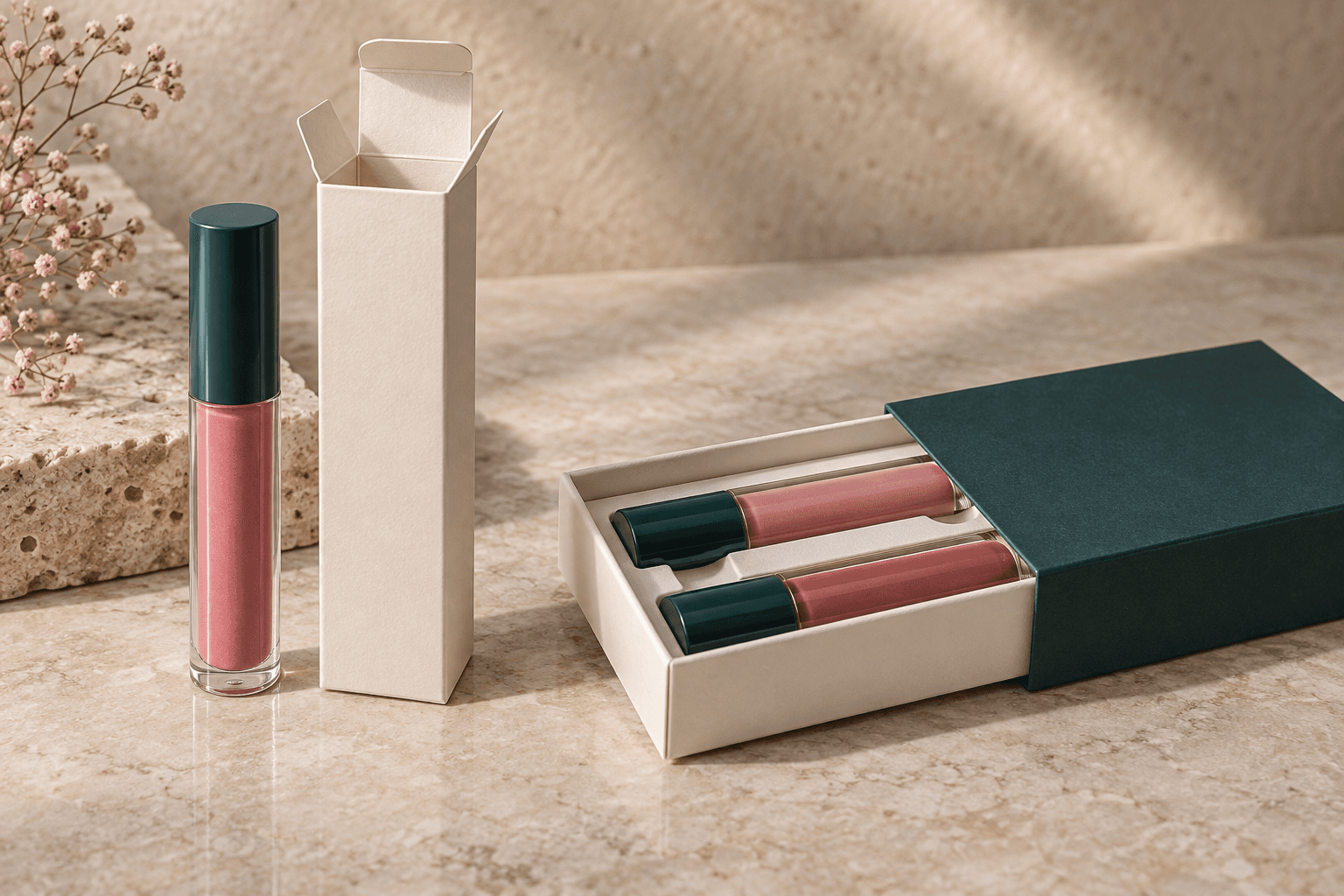
The most suitable lip gloss packaging box styles depend on how the product is sold and removed, not just the length of its tube. A tuck-end folding carton is a practical starting point for an individual closed unit; a sleeve needs a tray or another structure beneath it; and a multi-product presentation usually needs deliberate positioning. Compare those choices against the actual tube, cap, applicator assembly and intended pack-out before selecting the visual treatment.
A long wand does not automatically require a longer carton than the closed product. The wand normally sits inside its container, while the cap, shoulder or decorative end can establish the largest external dimension. This guide compares secondary box structures for lip gloss, with particular attention to slim products, double-ended formats and shade sets. It does not address formula compatibility or replace the primary-container supplier’s closure specifications.
Compare the structures before choosing the finish
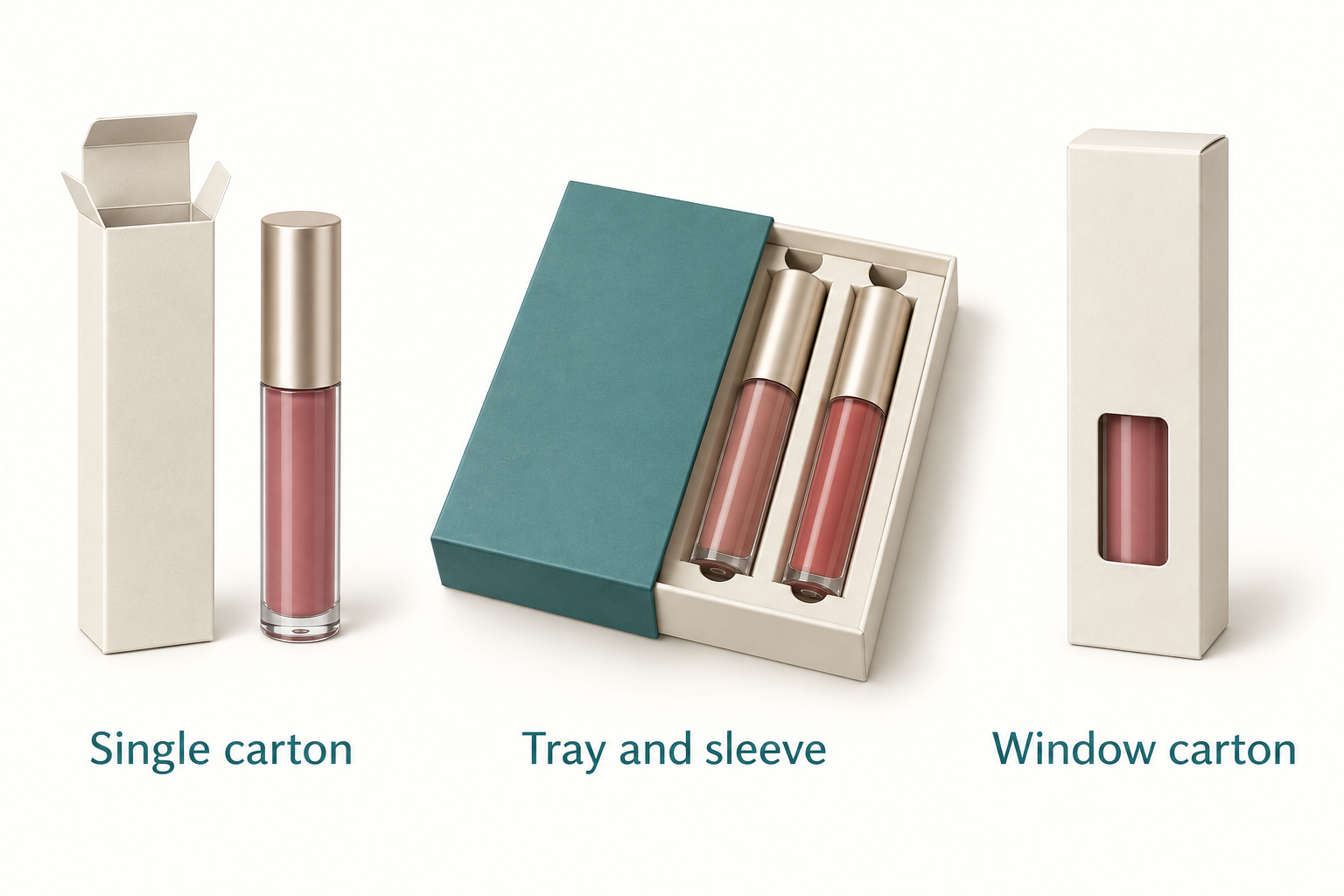
| Structure | Useful starting situation | Decision to resolve |
|---|---|---|
| Tuck-end folding carton | One tube sold as a single retail unit | Loading direction, closure engagement and removal grip |
| Sleeve over a tray | A deliberate slide-out reveal or coordinated set | Tray retention, friction and whether the sleeve can slide unintentionally |
| Window carton | The visible tube or shade helps the purchase decision | Window placement, product orientation and remaining panel strength |
| Presentation box with fitted interior | Several glosses, a discovery assortment or a gifting format | Retention for every unit, removal access and assembly effort |
These are design directions rather than a ranked list. A structure that works for a short round gloss may not suit a long rectangular cap or a squeezable tube. Compare equivalent samples with the same product inside. Otherwise, a finish, camera angle or unusually generous prototype can make one option seem more suitable than the structure actually is.
First establish the closed product envelope
Record the complete closed height and greatest width and depth, then identify where those maximum dimensions occur. A cap may be wider than the bottle; an angled shoulder can catch an opening; a raised band can rub a tight internal surface. Photograph the front, side and base with a clear indication of the intended display face.
A component name can be misleading if treated as an outside measurement. For example, HCP’s 13 mm Standard Lip Gloss distinguishes its neck size from its larger external diameter and total height. The lesson is to read the dimensional drawing, not translate the neck designation into carton width. It is an illustrative supplier reference, not a PearlFold component specification.
For a double-ended gloss, document both caps in their fully closed positions and the complete assembled length. Note whether either end can rotate or separate during handling. If the sale unit includes an applicator as a separate item, its storage position belongs in the pack-out drawing; it must not be silently assumed to fit alongside the tube.
Tuck-end cartons: a focused choice for individual glosses
A conventional folding carton gives a single tube a defined set of information panels and a familiar opening. Its useful simplicity depends on fit. The product should enter without snagging, the closure should seat without pressing against the cap, and the consumer should have a realistic way to grip the tube on removal.
Review the top and bottom operations separately. The end used to load the gloss may not be the end the consumer opens. A small change in flap arrangement can affect how the tube passes the closure and whether the cap is exposed first. Ask for a physical demonstration rather than relying on the names of carton styles alone.
Do not add an insert simply because the tube is slim. A suitable carton may already give an acceptable fit. If a narrow bottle sits beneath a much broader cap, however, local support may help control its position. Evaluate whether that support creates a difficult extraction point or adds unnecessary packing steps.
Sleeves: useful when the inner pack has a job
A sleeve is an outer wrap, not a complete answer to retention. Establish what sits inside it: a tray, an existing carton or another load-bearing structure. The inner component should keep the gloss from falling out when the sleeve moves and should present the product in a predictable position.
For a two-shade set, a tray can create a clear side-by-side arrangement. Yet the same arrangement can waste material if the set is rarely sold together or if individual products need separate retail identification. Decide whether the sleeve communicates a genuine bundle or merely adds a decorative layer to two already complete boxes.
Prototype the sliding action using the intended surfaces. A sleeve that is comfortable to remove from an empty tray may behave differently after the tray is loaded or the decoration changes. Check both excessive looseness and excessive friction. Agree what retains the assembly during distribution; a polished reveal is not evidence of shipping protection.
Windows: make visibility a controlled decision
A window can show the gloss container, but it needs a reason. If seeing the actual shade is useful, position the viewing area around the relevant part of the tube and check it with the real filled product. A window that mostly reveals an opaque cap does little for shade recognition.
Movement matters here: a tube that rotates can hide its label or shift the intended color view. Resolve orientation with the interior geometry rather than assuming the product will stay where it was placed for the photograph. Also inspect where the window ends relative to folds and closure areas.
Window construction and any film affect material choices and disposal guidance. Do not make a blanket recyclability claim from the word paperboard. The appropriate message depends on the completed structure and its components. For a broader look at available structures, the box styles guide explains how the outer form and opening experience relate.
Sets need a product map, not just a larger box
List every gloss, its orientation and how the buyer removes it. A set with short and long formats may need different support positions even when the outer presentation looks symmetrical. Keep removal spaces away from vulnerable decoration and avoid making the customer pull on a cap to release a tightly held bottle.
Plan the identification system at the same time. Can staff confirm the correct shades before the box closes? Can the buyer distinguish them without removing every unit? If a seasonal assortment changes, record which cavities or labels change with it. A shared exterior does not make all assortments interchangeable.
Discuss the commercial requirements through PearlFold’s lip gloss packaging page, but keep the article decision focused: what does the structure need to hold, reveal and explain? A rigid presentation may be appropriate for one gifting brief and unnecessary for a routine single-tube sale.
Run a short comparison trial with the real pack-out
Prepare a sample of each serious option, using the same product revision and intended contents. Record loading steps, closure behavior, visible orientation, product movement and removal effort. Include a person unfamiliar with the prototype: their handling can reveal an opening assumption that the designer no longer notices.
Separate appearance approval from protective validation. The retail carton is only one part of the packed shipment. ISTA’s test-procedure overview distinguishes different package testing approaches; choosing an appropriate evaluation depends on the actual distribution system. Do not label a gloss box protective or transit-tested simply because a sample survives a casual hand shake.
Bring the preferred structure, the unresolved observations, approximate quantities and sales-channel details to the custom quote discussion. That lets the proposed box address a concrete pack-out problem instead of starting with an unsupported request for the most premium style.
Questions about lip gloss packaging box styles
Which box style suits a slim lip gloss tube?
A tuck-end carton is a useful first option to evaluate. Confirm cap clearance, loading direction and finger access; the narrow shape alone does not establish the final structure or board specification.
Should I measure the wand separately?
Record the closed assembled tube for ordinary carton sizing. Document a separate wand only when it is packed separately or when its assembly affects the retail configuration being reviewed.
Can a sleeve hold a gloss without a tray?
Only if the complete design provides suitable retention. An open wrap by itself may let the product slide out, so explain the retaining mechanism rather than treating the sleeve as a closed carton.
Do transparent gloss tubes need windows?
No. A window is a presentation choice. Assess whether it gives useful visibility, maintains orientation and justifies its construction complexity compared with printed shade identification.
When is an insert worth considering?
Consider one when it solves movement, orientation or multi-item organization. Compare its benefit with extra assembly and removal effort, and test it with the exact cap and bottle profile.
Can several shades share one structural design?
Yes, when dimensions and packing requirements match. Keep shade artwork and identifiers controlled, and verify any alternate tube or cap rather than assuming a visually coordinated range is dimensionally identical.
Is a rigid box better for every gloss set?
No. Consider weight, presentation, distribution and the intended price position. A well-designed folding structure or tray-and-sleeve system may meet the brief without the bulk of a rigid construction.
How should a double-ended gloss be positioned?
Show both closures and the full assembly in the pack-out record. Support the product where the body can accept it, and check that loading or removal does not loosen either end.
Does a tighter carton always protect better?
No. Excessive tightness can complicate packing, catch the cap or abrade decoration. Fit needs to balance controlled movement with practical loading and removal in the chosen materials.
What should accompany a structure quotation request?
Provide representative products, closed dimensions, unit or set configuration, artwork needs, quantities and distribution context. Add the specific concern—visibility, movement or reveal—so different options can be compared fairly.