

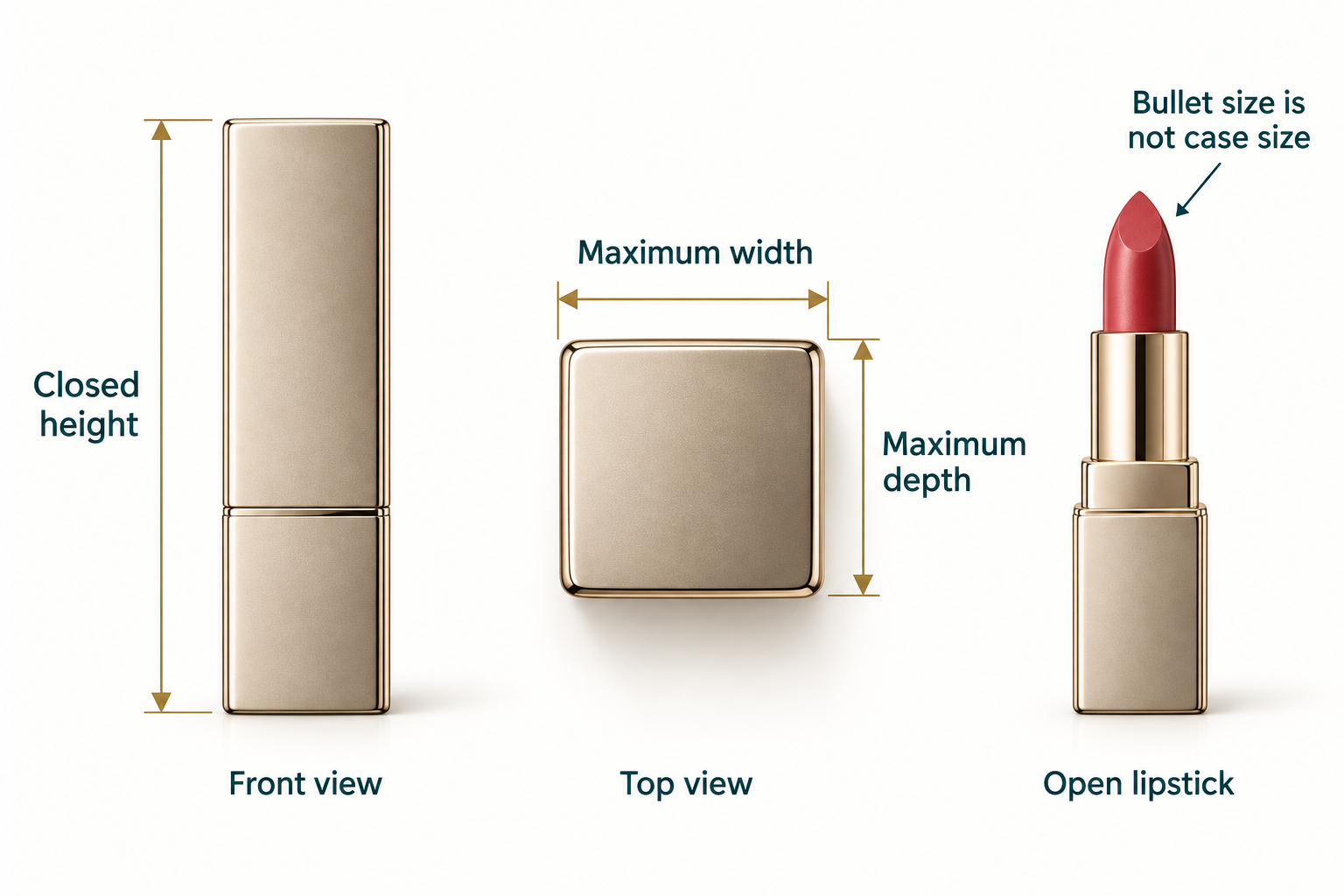
To measure lipstick packaging for a carton, use the complete, closed retail unit: base, mechanism, decorative shell and fully seated cap. Record its greatest height, width and depth, including any projecting decoration. The bullet diameter or mechanism size is not the outside size of the finished lipstick. Give the carton designer the actual product measurements, then review the proposed internal space and opening with physical samples.
This guide concerns secondary paperboard packaging for solid lipstick units, not the design of the lipstick mechanism itself. Its particular challenges are small dimensional differences, narrow carton proportions and shade identification across many otherwise identical products. The goal is a usable measurement record that separates product geometry, proposed carton dimensions and variant artwork before any of them becomes a production assumption.
Start with the finished lipstick, not the mechanism drawing
Confirm which sample represents the unit customers will receive. Fit the final cap and any decorative outer shell; retract the lipstick into its normal storage position. A bare mechanism, undecorated development sample or cap from a different supplier revision is not necessarily representative. If only preliminary components exist, label the measurements provisional and identify what will change.
The distinction is visible in primary-component documentation. Aptar’s Iconic lipstick mechanism lists mechanism cup sizes and describes use with an outer casing. Those internal component dimensions cannot establish the finished carton footprint. This is an example of different specification layers, not a recommendation to use that particular mechanism.
Also distinguish a conventional lipstick from a refill. A refill may have a temporary protective cover and a different height or diameter from the assembled reusable case. If they are sold separately, document two retail units. If sold together, record the arrangement and every component rather than applying the case dimensions to the full kit.
How to measure lipstick packaging: the six-part record
Choose millimeters or inches and use that unit consistently. Millimeters often make small differences easier to record without repeated fractions. Identify the instrument, sample reference and measurement date. A caliper can help with narrow components, but avoid compressing a flexible shell or scratching a decorative finish; agree the measuring method with the component supplier where necessary.
| Record | What to measure or describe | Why it matters |
|---|---|---|
| Closed height | Standing base to highest point of the seated cap | Establishes the complete upright envelope |
| Maximum width and depth | Largest outside dimensions, with the cap included | Prevents sizing only around the narrower mechanism or base |
| Cross-section | Round, square, oval, tapered or irregular | Shows whether rotation changes the required space |
| Local projections | Cap rim, emblem, clasp, collar or raised decoration | Identifies possible snagging and rubbing points |
| Finished unit weight | Complete filled lipstick with its cap | Informs support and packed handling review |
| Pack-out direction | Which end enters first and which face should be forward | Connects dimensions to loading, opening and shade identification |
For a round case, check more than one height along the body. The cap or bottom ring can be wider than the central barrel. For a rectangular case, record width and depth independently even if it appears square. For a tapered design, photograph the widest section and note its position. A single diameter cannot describe every profile.
Measure several representative units if available, noting the observed range rather than reporting a false universal average. Sample variation is not the same as a contractual manufacturing tolerance: request the supplier’s drawing and agreed tolerances as separate evidence. Keep the original sample identifiers so an unusual reading can be checked again.
Keep product size and carton size in different columns
The measured lipstick is an input to structural design, not an instruction to make a carton with identical inside dimensions. Space is needed for loading and removal, and the available interior is affected by folds, closure flaps, board thickness and any retaining feature. There is no defensible single clearance to add to every lipstick.
As an illustrative example only, suppose a closed case measures 76 mm high with a 22 mm square cap and a 20 mm square base. The cap establishes the widest envelope; the smaller base may still move inside that envelope. A designer might investigate a snug conventional carton or a local retaining feature, depending on handling and presentation. None of those example dimensions defines an approved carton or a required clearance.
Ask the supplier to distinguish internal dimensions, external dimensions and the flat dieline. Do not measure a flat panel and assume it equals usable inside space. The approved sample should settle whether the lipstick loads cleanly, the top closes without pressure and the consumer can remove the case without pulling off its cap.
Resolve narrow-carton behavior before approving the artwork
A slim pack can look elegant in a rendering yet be awkward to assemble or identify. Try the actual loading sequence with the intended product and closure direction. Check whether flap tips catch the cap rim, whether fingers can grip the product and whether repeated insertion marks the finish. The solution may be a structural adjustment rather than more empty space.
Review the box in its expected retail arrangement. A narrow individual carton may depend on a shelf tray or other merchandising support; do not assume it will stand securely in every setting. If vertical display is important, demonstrate that arrangement with samples. If the product lies flat in an ecommerce order, assess that orientation separately.
An insert is useful only when it resolves an identified need, such as controlling a narrow base beneath a wider cap or positioning multiple units. It also introduces a part to assemble and remove. PearlFold’s lipstick carton options are the commercial destination for discussing the structure after those requirements are clear, rather than treating an insert as a default upgrade.
Separate shade identity from structural identity
Many lipstick shades can share a structure if their finished components and pack-out are genuinely the same. Record the shared structural revision once, then maintain a shade matrix for changing artwork. Useful fields include shade name, shade code, approved copy file, barcode reference, label position and pack-out identifier.
Do not assume a matching appearance means identical dimensions. A seasonal cap, refillable edition or weighted base may create a separate structural variant within the range. Group products by verified physical compatibility first and graphic similarity second. Identify any exception explicitly instead of asking production staff to infer it from a product name.
In the sample review, place different shade cartons beside each other and inspect the end panels that will actually remain visible in storage or display. A beautiful front face does not solve shade picking if the distinguishing information is hidden underneath. Treat final barcode and required-label approval as separate artwork checks, not something the measurement worksheet can certify.
Approve one traceable pack-out combination
Keep the product sample, carton prototype and artwork revision connected in the approval record. Note the product orientation, any insert, the loading sequence and observations from opening and removal. A useful sign-off states what was reviewed and what remains provisional, rather than simply saying the box looks good.
Check decorative contact after handling, not only at first assembly. A tight fit that scrapes a metallic shell is not necessarily preferable to a slightly different structure. Conversely, an oversized carton can allow unnecessary movement. Evaluate the actual material and finish combination; appearance alone cannot establish protective performance.
When sending the project for quotation, include the closed-unit drawing, representative samples, shade matrix, approximate quantities and intended sales channel. If a component changes later, flag it for a fit review before relying on the previous carton. The PearlFold quote form can carry those project details and the specific questions you need the proposed structure to resolve.
Lipstick carton measurement questions
Should I measure lipstick open or closed?
Use the closed retail configuration for the carton envelope. An open view can help explain the mechanism and cap relationship, but the extended bullet does not define the ordinary closed carton height.
Does a 12 mm lipstick mechanism need a 12 mm carton?
No. A mechanism dimension describes an internal component, not the finished case. Measure the assembled outer casing and cap, then have the carton structure developed around that complete unit.
How much clearance should I add?
Do not apply a universal allowance. Ask the designer to propose clearance for the actual shell, board, folds and pack-out method, then assess loading and removal with a physical sample.
Can one carton work for every shade?
Potentially, if the finished geometry and packing requirements match. Keep shade artwork and barcode references controlled separately, and verify exceptions such as special-edition caps before sharing the structure.
Should a magnetic cap be measured differently?
Measure it fully seated in its normal closed position. Record the cap-to-base relationship and check that insertion or removal does not unintentionally separate the cap from the product.
What if the cap is wider than the base?
Use the cap’s maximum dimensions for the envelope and record the narrower base too. The designer needs both to judge movement and whether local retention is worth adding.
Can a refill use the original lipstick carton?
Only after a separate fit assessment. Refills can differ in height, cover shape and presentation, so the complete refill retail unit needs its own documented measurements even within one range.
Do I need an insert for a single lipstick?
Not automatically. Identify an actual movement, orientation or presentation problem first. Compare a suitable carton alone with a retained version and consider assembly and consumer removal as well as appearance.
Are supplier drawings enough without samples?
Drawings are useful for early development, especially when tolerances are stated. Final decorative samples still help reveal contact, cap seating and handling details that a nominal dimension does not fully communicate.
What requires a new fit check after approval?
Changes to the cap, outer shell, decoration thickness, retaining feature or carton material can affect the fit. Record the change against the approved combination and ask which sample checks need repeating.