


A glass face-cream jar carton should be sized from the complete closed, filled jar—not the stated cream weight or inner well. Measure the widest outer wall or cap, total closed height, base footprint and filled weight. Then compare a direct-fit carton with localized support only if the sample reveals movement, unstable seating, difficult removal or a defined presentation need. Oversizing can allow a heavy jar to shift and consumes space; excessive tightness can rub decoration or load the lid.
This face cream jar packaging guide focuses on carton geometry, contact and approval. It does not assume that every glass jar needs an insert or that a snug sample proves transit protection.
Identify the finished jar construction
Document the jar, cap, liner or disc, label, decoration and fill. Thick walls, double-wall constructions and refill systems can make exterior dimensions much larger than nominal capacity suggests. HCP’s official Azure 15 ml jar, for example, lists a 51 mm diameter and 50.5 mm height, while its Echo 50 ml refill jar lists 66 mm diameter and 56.7 mm height. These examples show variation; they are not PearlFold specifications.
Build a jar measurement record
| Jar feature | Record | Carton implication |
|---|---|---|
| Outer body | Maximum width/depth or diameter | Controls horizontal envelope |
| Closed cap | Maximum profile, overhang and height | May be wider than the base and should not be compressed |
| Base | Footprint, recess and edge condition | Determines stable seating |
| Finished surfaces | Label, spray, print or metallized areas | Identifies rubbing-sensitive zones |
| Filled unit | Weight and center of mass | Informs handling and package evaluation |
Measure several production-intent units when available. Mark measurement points on a photo and record the instrument. A single diameter without its height or contact points is not enough.
Size from the outer jar, not the cream well
The inner fill cavity can be surrounded by thick glass, an outer plastic wall or a replaceable cup. Two jars with the same fill may therefore need different cartons. Use the actual external pack tied to the SKU.
Confirm the cap is fully seated in the approved retail state. Do not reduce carton height by forcing a lid, compressing a liner or relying on top-flap pressure.
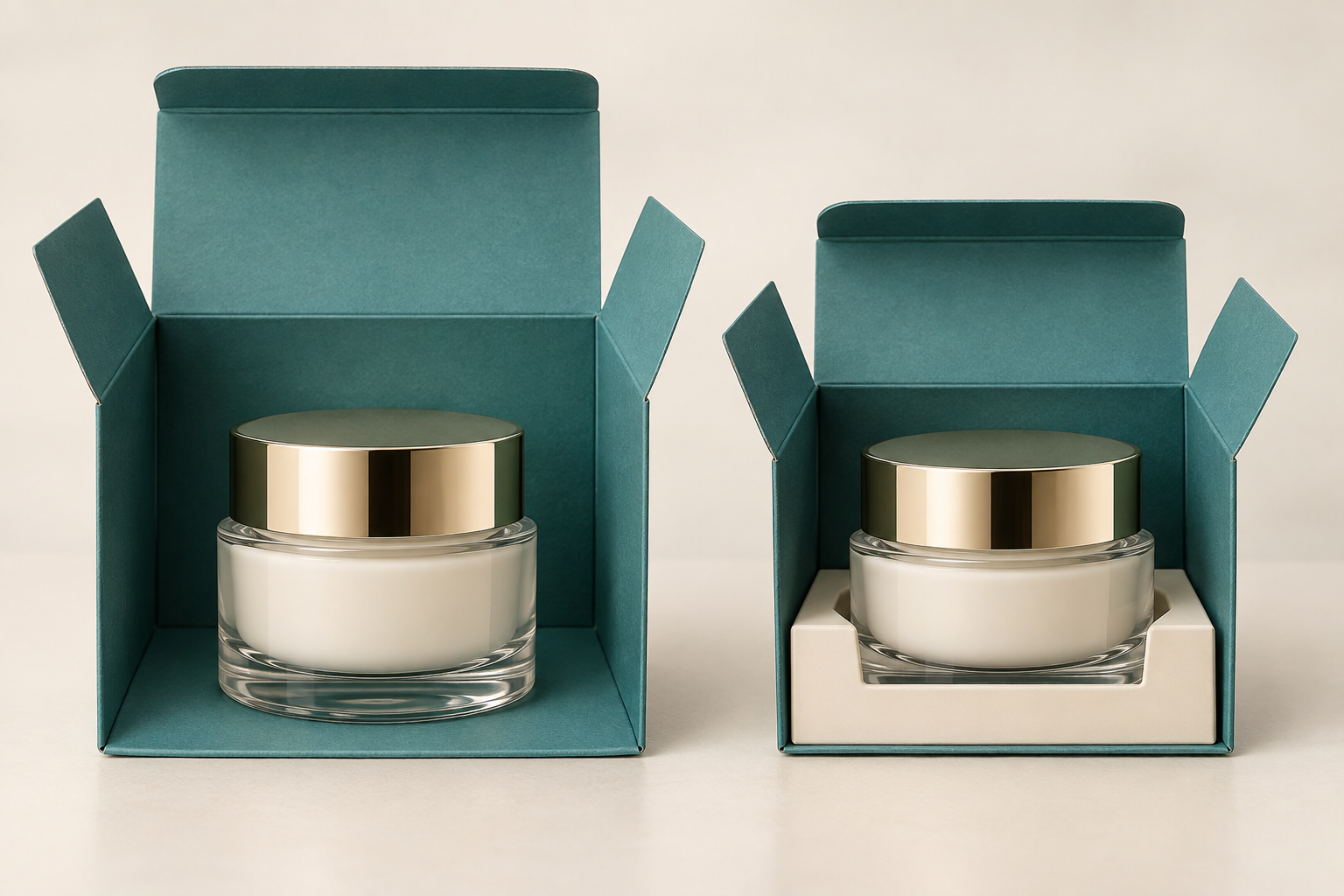
Compare direct fit before adding support
Build a simple folding-carton sample with purposeful clearance. Observe lateral movement, vertical headspace, rotation and contact separately. A stable cylindrical jar may not need another component; an asymmetric, tapered or presentation-critical jar may benefit from localized folded-paperboard positioning.
If support is proposed, state its function. A base locator can control position but does not automatically cushion glass. A shoulder feature may interfere with cap removal. Compare candidates using the same filled jar and acceptance criteria.
Keep glass edges and the lid in view
Inspect where the base edge, side wall and cap approach paperboard. Avoid point loading on fragile or decorative areas. Final sprayed, frosted, printed or labeled samples reveal contact that clear undecorated prototypes can hide.
Watch the closure flaps during packing. A carton can have enough final height while an inner flap scrapes across a wide lid. Review erection, loading and closure—not only the closed mockup.
Design body access for removal
A low jar can sit deep below the opening. Ask a reviewer to remove it without pulling only on the lid. Finger access, a changed orientation or a modest opening allowance can be more useful than increasing every dimension.
Where support is used, confirm it stays in the carton and does not clamp the jar. Record removal effort and any cap loosening.
Use filled weight in the approval
Filled weight affects handling even when the exterior dimensions are unchanged. Use the intended formula quantity and all components for final review. Do not extrapolate from an empty jar or lightweight plastic surrogate.
Weight alone does not prescribe board grade or insert material. Those choices require the complete structure, production and distribution brief.
Control variants and refills
Different cream formulas may share an identical finished jar; confirm that through component references. A refill cup, special cap, spatula or promotional sleeve can change the pack-out. Record each included item and its position.
Use a SKU-to-packaging matrix so artwork and structural revisions remain linked. Recheck limited editions rather than assuming a familiar capacity means a familiar fit.
Validate the packaged-product system
Fit and usability are not transit certification. Define acceptable condition and evaluate the retail carton together with its shipping configuration. ISTA advises documenting product/package variations and considering retesting when configuration, size, weight, material or components change.
Retain the approved jar, drawing, board, pack-out photographs and applicable test evidence. Review custom face-cream box options and include the filled jar data in a quote request.
Compare carton volume with usable product access
Reducing exterior size is useful only while the jar can still be packed and removed consistently. Compare candidate structures using finished dimensions, material area and usable access rather than visual compactness alone. A very shallow headspace can look efficient but force the customer to pry against a cap edge; a deep recess can conceal the jar and create difficult loading.
Record who packs the jar, what end opens first and how the customer reaches the body. If a finger recess is proposed, verify it exposes a safe grip area and does not weaken the support feature during erection.
Coordinate artwork with the squat carton proportion
Jar cartons often provide wide panels with limited height. Prioritize product identity, net contents, required copy and opening cues instead of shrinking a tall-bottle layout. Review typography and barcode placement at printed size. If a jar family uses several diameters, maintain shared graphic rules while adapting the dieline to each structure.
Do not approve artwork on a temporary oversized carton. The final panel proportions may change hierarchy, line breaks and quiet areas. Release the structural drawing first, then place and proof artwork against it.
Separate accessories from the jar contact path
A spatula, refill cup, leaflet or sample sachet adds another component with its own movement and removal sequence. Decide whether it sits above, beside or separately from the jar. It should not become an uncontrolled hard object against glass or decoration, and it should be visible or discoverable without the customer dismantling the pack.
Load the complete set for sample review. An empty accessory cavity or missing leaflet changes available space and can produce a misleadingly stable prototype.
Release a reproducible specification
Record the exact jar and cap revisions, actual measured units, accepted carton and support drawings, board, artwork, loading instructions and review evidence. State the boundaries of approval. If only visual fit was checked, do not label it as transit validation. If one jar size was tested, do not extend the result to every size in the family without justification.
This record protects later reorders from quiet substitutions and gives quality teams a clear reference when a contact mark, loose fit or packing difficulty is reported.
Review the shipping case or e-commerce overpack at the same release point. The retail carton may be visually compact yet placed loosely inside a larger system. Record case count, orientation and dividers where applicable so the evidence relates to the configuration that will actually move through distribution.
Finally, check the customer-facing pack under ordinary shelf lighting. Wide jar cartons can expose print and finish variation differently from tall bottle cartons. Confirm panel alignment, lid-side orientation and shade or formula identification on the assembled production-intent sample, not only on a flat proof.
Keep one approved assembled reference with its dated specification. Use it for comparison, while recognizing that storage and ageing can change a physical sample over time.
Face-cream jar packaging questions
How should a cream jar be measured?
Measure the complete closed exterior at its widest and highest points, including cap overhang, labels, feet and decoration.
Does a glass jar always need an insert?
No. Add support only when the direct-fit candidate cannot meet a defined positioning, contact, presentation or evaluated performance requirement.
How does filled weight affect the carton?
It changes handling and support questions and must be represented in approval and applicable package testing.
Can the top flap rest on the lid?
Do not assume the lid is a load-bearing surface. Provide reviewed clearance and confirm closure flaps do not scrape or press it.
Can several formulas share one box?
Yes when the finished jar geometry and approved pack-out match; control artwork and formula identification separately.
Should a jar carton be square?
A square folding carton is common, but suitability depends on stability, board, packing, presentation and distribution needs.
How can decoration scuffing be checked?
Use final-intent decoration, inspect identified contact zones after packing/removal and complete the agreed handling or test sequence.
Can a carton stop a glass jar from breaking?
Do not make that guarantee from fit alone. Protective performance requires evidence from the complete packaged-product configuration.
Should a spatula be packed with the jar?
If included, assign it a position that does not rub the jar or impede removal, and review the complete set.
What should be sent for structural review?
Send the closed filled jar, dimensions, weight, component references, decoration, accessories, quantity and distribution brief.