
Package eyeshadow around the finished closed palette or compact, not around its pan count. Measure the outer body, hinge, clasp and thickness; identify surfaces that should not receive concentrated pressure; and choose support that controls movement while leaving a practical removal point. A single compact, a refill pan and a large mirrored palette are different packing problems even when all contain pressed eyeshadow.
This eyeshadow packaging guide focuses on secondary cartons, sleeves and presentation structures. It distinguishes protecting and presenting the finished product from manufacturing the compact or validating the powder formula. A well-fitting outer box cannot correct weak pan retention, a defective hinge or an inadequately secured mirror. The useful starting point is therefore a clear definition of what enters the box and which parts of that assembly need particular care.
Which eyeshadow format are you actually packaging?
| Sale unit | Primary fit concern | Useful starting approach |
|---|---|---|
| Single closed compact | Clasp or hinge projects beyond the apparent body | Carton developed around the complete external envelope |
| Multi-pan palette | Broad face, edge support and changing thickness | Assess a carton or retained tray against the actual closed palette |
| Loose refill pan | Exposed powder and vulnerable pan edge | A specifically designed protective carrier, not a miniature compact carton |
| Gift set with brush or accessory | Components can contact the palette or obstruct removal | Separate retained positions and an intentional unpacking order |
Do not select the box simply from labels such as four-pan or nine-pan. Pan size, spacing, mirror construction and the surrounding body can change the footprint substantially. Treat pan count as a contents description and the finished dimensions as separate structural inputs.
A useful supplier example is HCP’s Radical Solo Eyeshadow Compact: its published well dimensions differ from the overall compact dimensions, and the design includes a clasp recess and hinge. The example illustrates why the powder well alone cannot establish the outside carton. It is not a specification for a PearlFold project.
Measure the closed assembly in three views
Use top, side and hinge-side views of the actual finished sample. Record maximum width, depth and thickness, including any projecting clasp, hinge or decoration. Identify whether the lid is flat or domed, and whether the bottom has feet or an uneven profile. Those details can determine where an insert contacts the compact.
Show the intended orientation in the box. A rectangular palette may physically fit in two directions while only one gives a comfortable opening sequence. If a printed front or shade window must face the buyer, record that requirement instead of expecting the structural designer to infer it from a product photograph.
Measure a selection of representative units and preserve the observed range. Obtain component tolerances from the responsible supplier rather than converting a handful of measurements into a manufacturing guarantee. If decoration or final filling is incomplete, say what is provisional and identify when finished samples will be available.
Distinguish movement control from pressure on the lid
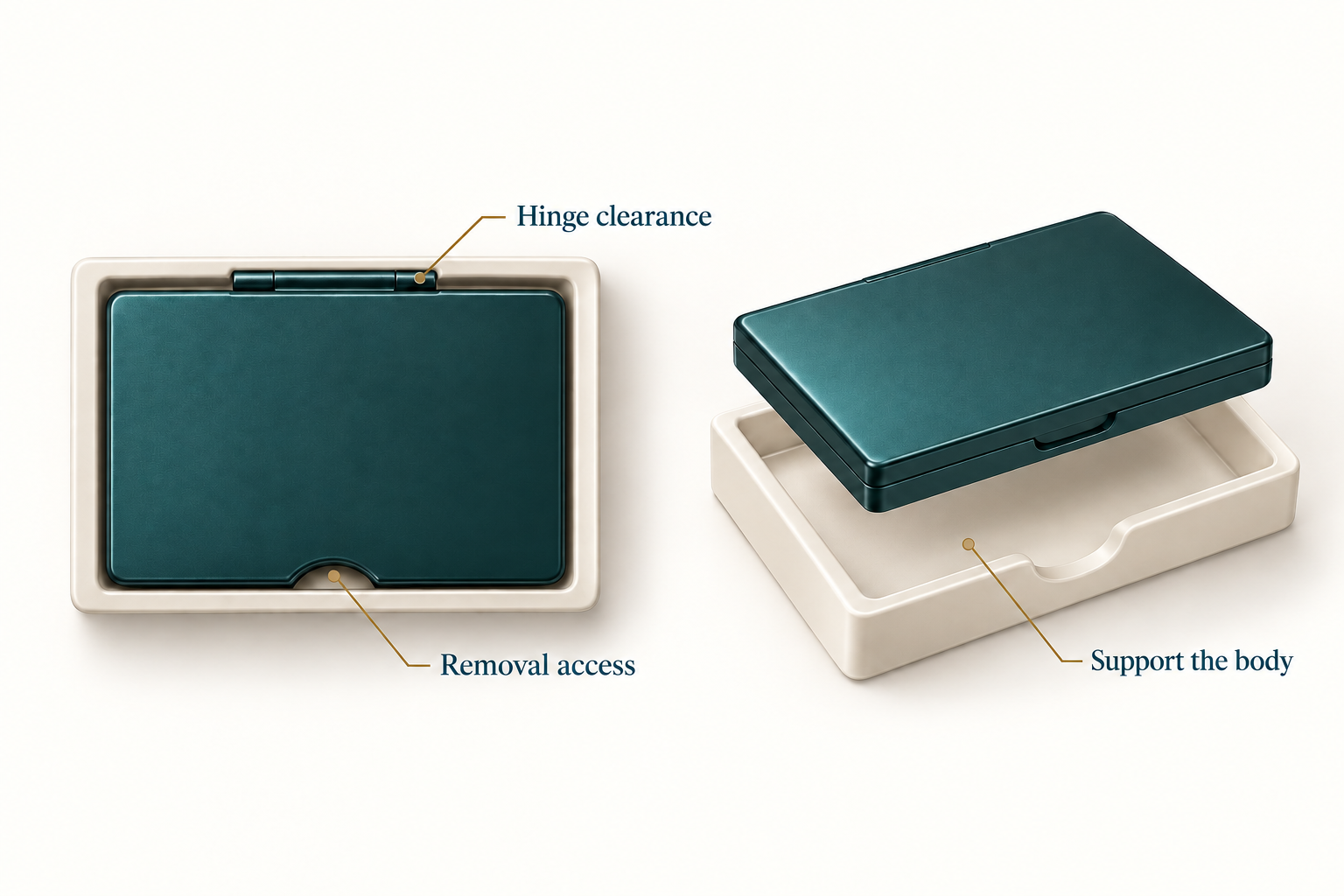
A package should not be judged only by whether the palette rattles. Eliminating movement by pressing hard against the lid can create a different problem, particularly where the assembly contains a mirror or a flexible cover. Ask the designer to explain which surfaces support the weight and which surfaces locate the product.
For a broad palette, review the edge and underside contact together. A support that holds only two small points can leave another part of the assembly free to move. Conversely, a full-face contact area may interfere with decoration or opening. There is no universal insert geometry: support has to suit the actual compact and distribution brief.
A useful sample-review notation marks three types of area on a photograph: intended support, removal access and avoid-contact zones. Confirm those zones with the product supplier where structural sensitivity is uncertain. The drawing communicates the review question; it does not prove a design is safe under transport loads.
Choose the opening around the buyer’s first action
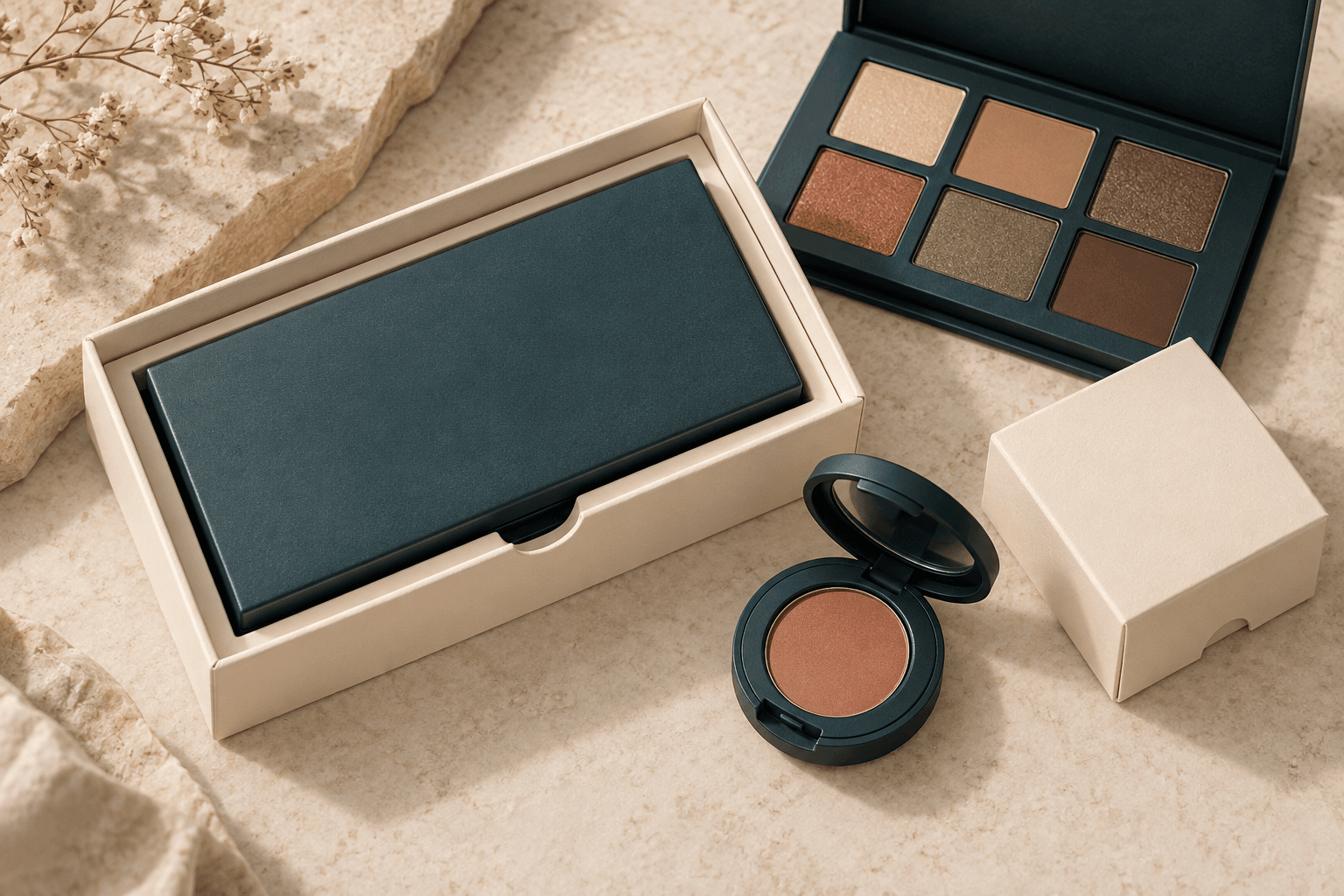
A folding carton can be appropriate for a single palette when it provides practical fit and removal. Check whether the consumer can withdraw the compact by its body without pulling on the clasp or opening the lid inside the box. A finger recess or a different product orientation may solve an access problem more cleanly than a much larger carton.
A sleeve can preserve a broad graphic face and create a sliding reveal, but determine what prevents the compact from slipping out. If a tray is added, assess sleeve friction with the loaded tray. The outer wrap and inner support form one system; neither should be reviewed in isolation.
A presentation structure may make sense for a gifting brief or a set with accessories. It adds choices about cavities, lid clearance and unpacking sequence. Do not equate greater bulk with better protection. Compare the complete structure and its intended shipment rather than assuming a rigid exterior settles every support question.
Use PearlFold’s eyeshadow packaging options to discuss the commercial direction once the format is defined. Keep the brief specific about a closed compact, palette, refill or set so the proposed box addresses the correct product.
Refill pans need their own protective approach
A loose pan is not a small finished compact. Its powder may be exposed, and the thin pan edge may be the only available locating surface. Define the primary protective cover or carrier before assuming a printed outer carton can directly hold the refill.
The carrier should be evaluated for handling and removal without contact with the powder surface. Ask how a buyer lifts the refill out and transfers it into its intended palette. A tight cavity with no access point can encourage pressing on the product or bending the pan, so extraction is part of the design brief.
When a refill is magnetic, compatibility with the destination palette belongs to the product system. Do not imply that a paperboard carrier establishes magnetic retention or formula suitability. The packaging record should identify the finished refill configuration and the responsible product reference without making unsupported performance claims.
Keep accessories from becoming loose internal objects
For a palette-and-brush set, record the brush length, protective cover and intended placement. The brush should not be able to slide across the palette face merely because both items fit inside the outer box. Consider whether the accessory can be removed independently without levering against the compact.
Include printed inserts, booklets and any protective sheets in the actual sample pack-out. A booklet added after fit approval can change the stack height or press on the lid. Record which component sits above or below the palette and whether opening the package displaces it.
For multiple palettes, use a component map that identifies each position. Review how the packer distinguishes similar-looking variants before closure. This is particularly useful for seasonal assortments, where a shared exterior can conceal a change in the contents and internal requirements.
Approve the product and shipping configuration together
Begin sample review with assembly, closure, orientation and consumer removal. Inspect for visible contact marks and unintended pressure after handling. Record any observation against both the compact revision and the packaging revision so a corrected sample can be compared meaningfully.
Then define the complete distribution pack. A retail carton, protective transit materials and shipping container play different roles. ISTA’s test-procedure guidance provides context for selecting an appropriate packaged-product evaluation; the relevant procedure depends on the shipment. A hand-carried presentation sample is not evidence that pressed powder or a mirror will withstand the actual distribution environment.
The samples and prototyping process is the place to resolve physical uncertainties before treating a visual concept as production-ready. For a quotation, send closed-product dimensions, component photographs, the intended pack-out and your specific protection or access concerns through the project inquiry form.
Eyeshadow packaging questions
Can pan count determine the box dimensions?
No. The same number of pans can sit in different body sizes and arrangements. Measure the complete closed palette, including its hinge and clasp, rather than scaling a box from pan count.
Should a mirror be included in the thickness measurement?
Measure the finished closed assembly with its intended mirror fitted. Also identify lid sensitivity and acceptable support locations; thickness alone does not describe how the assembly should be held.
Do single compacts always need inserts?
No. A suitable carton may provide adequate positioning for the brief. Consider a retaining feature when there is a defined movement or presentation problem, then assess removal as well as retention.
Can an insert press against the powder?
Do not assume exposed powder is a suitable support surface. Define a protective carrier and contact zones with the product supplier, particularly for loose refill pans without a closed compact.
Is a sleeve enough for a palette?
It depends on the complete retention system. Check whether the palette can slide out, whether a tray is needed and how the assembly behaves during handling in its actual distribution pack.
How do I account for a projecting hinge?
Include it in the maximum external dimensions and identify its location in the side view. Check clearance during loading and removal, not just while the compact is resting inside the box.
Should a brush share the palette cavity?
Only if the design deliberately separates and retains it appropriately. A loose brush can move against the compact, so document its position, protective cover and independent removal path.
Can several palette variants use one outer box?
Potentially, if the full pack-out fits and each variant is correctly supported. Verify differences in thickness, weight, accessories and identification instead of assuming a common front design proves compatibility.
Does a rigid box guarantee unbroken eyeshadow?
No. Formula integrity, pan retention, internal support and shipping conditions all matter. Protective claims need evidence from the relevant complete package evaluation, not just the outer box material.
What should change when a booklet is added?
Update the pack-out drawing and reassess stack height, lid contact and opening sequence. A seemingly small additional component can invalidate assumptions made when the original sample was approved.