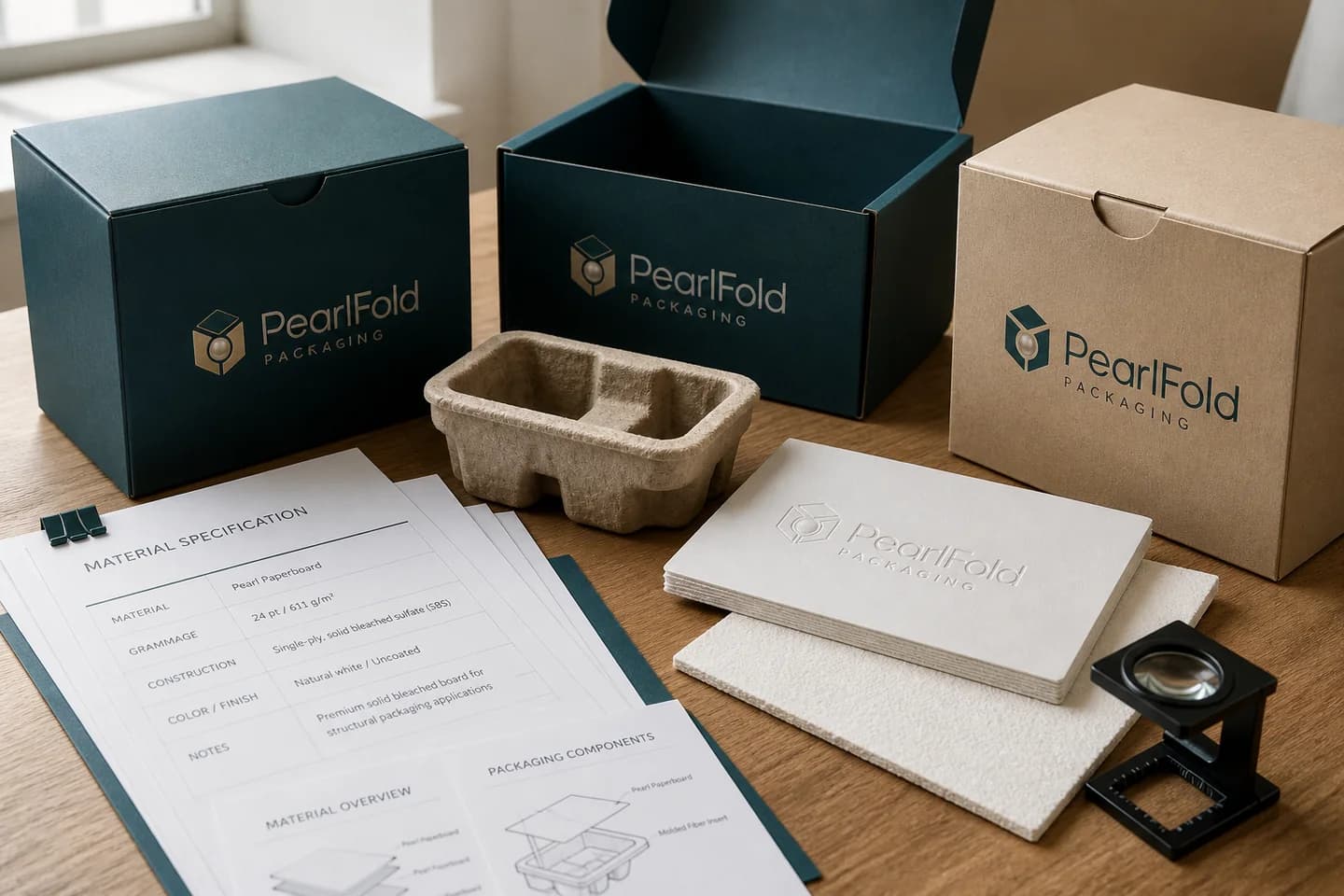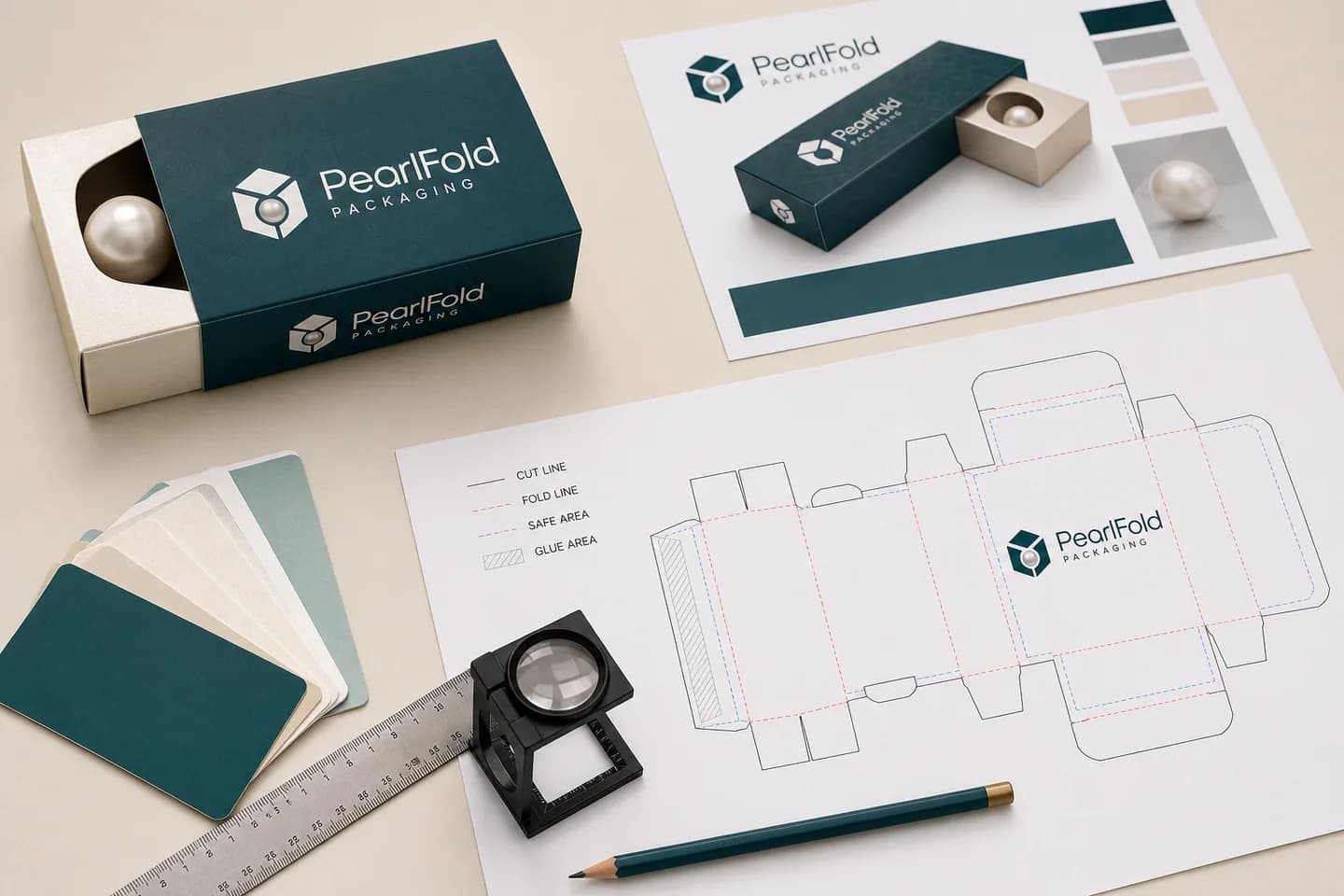


Cosmetic box production readiness means that the approved structure, product fit, material specification, artwork, quantity and release instructions agree with one another. A polished mockup is not enough. The team should be able to identify the exact files and physical references that control the order, with no unresolved change hidden in an email or an older proof.
This checklist is for the final review before releasing a cosmetic packaging order. It is not a replacement for the supplier’s prepress requirements, the brand’s regulatory review or the agreed inspection plan. If the project is still at the inquiry stage, begin with the packaging brief checklist; the checks below concern the later release decision.
What should a cosmetic box production readiness packet contain?
Keep one controlled packet for each approved structure and artwork combination. It should identify the SKU, finished product reference, dieline version, artwork version, materials, decoration, quantity and approval status. Where several products share a specification, list the covered SKUs explicitly rather than assuming that a common brand name means a common package.
| Release item | Question to close | Hold production if |
|---|---|---|
| Structure | Does the approved drawing match the finished product and sample? | Dimensions, opening direction or insert geometry remain provisional |
| Artwork | Does the production file match the signed proof? | Panels, copy, barcodes or finish plates differ |
| Materials | Are substrate and component specifications named? | The only instruction is a visual adjective such as “premium” |
| Quantity | Is the order broken down by approved SKU and version? | Totals conceal unresolved artwork or size variants |
| Acceptance | Are inspection scope and acceptance criteria agreed? | No one can identify what the approved reference controls |
| Authorization | Has the designated owner released this exact packet? | Approval refers to an obsolete file or an incomplete sample |
“Hold” is a workflow status, not a criticism of the design. It prevents the unresolved issue from being interpreted differently by purchasing, prepress and production. State the action needed to close it and who can authorize that action.
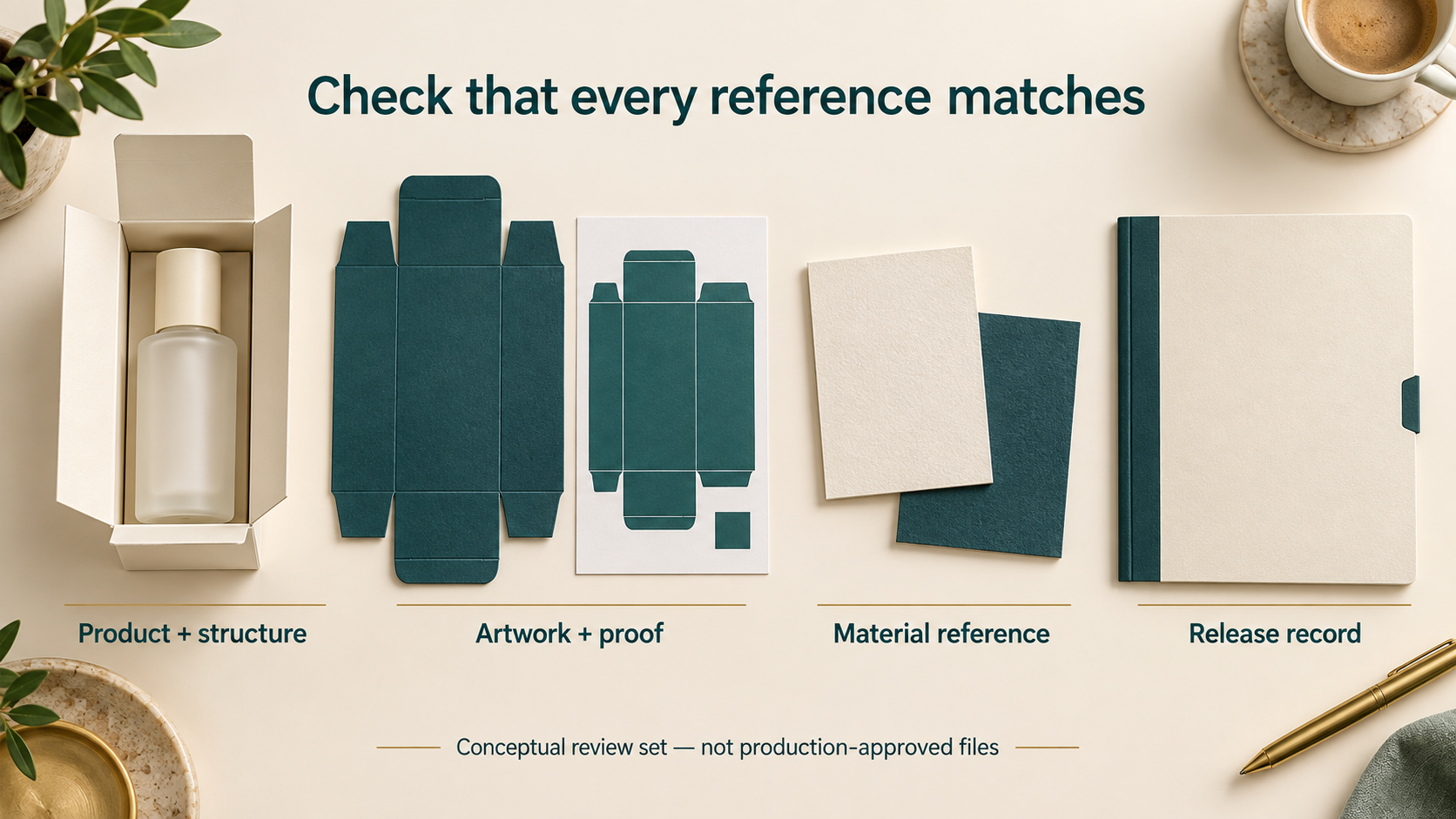
Gate one: reconcile the product, sample and dieline
Place the current finished product beside the structural sample and the approved drawing. Check the complete assembly, including its cap, label and any accessory. Confirm that the drawing identifies the intended internal and external dimensions rather than leaving their meaning ambiguous.
Load and remove the product using the agreed packing method. Check whether the opening admits the widest part, whether the closure operates without pressure on a pump or cap, and whether an insert stays seated. Review visible contact surfaces for rubbing or marking after handling. Record observations against the sample identifier.
A carton for a compact raises different questions from one for a tall bottle. A hinged compact may need clearance around its clasp; a pump bottle may need protection from unintended actuator pressure. Use the actual product-specific checks, not a generic instruction to confirm that everything “fits nicely.”
Gate two: compare production artwork with the approved proof
The file sent for production should be the file that was approved. Check its name, version and included assets. Open the reference PDF alongside it and reconcile every panel. A common failure is a correctly marked-up proof paired with an earlier source file that never received the final correction.
Confirm that structural guides remain separate from printable artwork. Review cut edges, fold areas, glue zones, panel orientation and the named layers or plates for special finishes. Follow the project’s supplied requirements for bleed, safe areas, fonts, images and color rather than inserting an assumed universal specification.
For the detailed file-preparation workflow, use PearlFold’s artwork guidelines. The release check should verify compliance with the approved instructions; it should not create a different set of technical requirements at the last moment.
Gate three: review copy and variant data at finished size
Check the product name, variant, supplied net contents, ingredient information, warnings, contact information and other required copy against the brand-approved source. The brand’s qualified reviewer remains responsible for market-specific wording and claims. A packaging approval should identify that reviewer rather than imply that a visual check establishes legal compliance.
Examine the smallest panels at actual size. Text that looks comfortable at a large monitor zoom may be difficult to read on the finished carton. Review contrast and the effect of background graphics or finishes without treating an aesthetic preference as a substitute for the applicable labeling requirements.
Compare all SKUs side by side. Check that the correct barcode and artwork version belong to each variant, including nearly identical names or shade numbers. If an insert, sleeve or outer box carries additional information, confirm that it agrees with the product it encloses.
Gate four: confirm barcodes as functional elements
Barcodes are not decorative graphics. Keep their source data, reproduction and placement under the relevant barcode standards and the brand’s implementation requirements. Review the actual printed configuration through the appropriate verification process; a successful casual phone scan is not a universal quality assessment.
For 2D retail codes, GS1’s implementation guideline specifically discusses quiet zones and interference from surrounding artwork or packaging features. Keep folds and other interfering elements out of the required clear area. The applicable symbol size, quality and data requirements must still be confirmed for the intended use.
If a code opens a web destination, test the intended address as well as the graphic. Confirm that it belongs to the correct product and does not depend on a temporary development link. Assign an owner for maintaining that destination after the cartons are distributed.
Gate five: replace appearance words with a specification
“Thick board,” “gold finish” and “soft matte” can describe a direction, but they do not uniquely identify production materials. Confirm the substrate reference, relevant material properties, coating or lamination, finish reference and any insert components in the written scope.
Check how the finish interacts with the structure. Decoration close to a crease, a dark surface that marks visibly, or small reversed text may require a different approval reference from a simple printed panel. Record which sample or proof controls color, texture and registration, including any limitations of that reference.
Do not carry an environmental statement forward merely because the material looks unchanged. If the artwork includes a sourcing, recycled-content or recovery claim, the responsible reviewer needs evidence for the exact component and wording. Unresolved claims belong on the hold list, not in tiny qualifiers added after approval.
Gate six: review packing, acceptance and commercial scope
Confirm how the empty package will be supplied and who performs assembly. If an insert needs folding, establish its order of operations. Check whether the people packing the product can follow the sequence consistently without forcing the item or touching a vulnerable decorated surface.
Agree the inspection plan and acceptance criteria appropriate to the order. Identify the approved references, the attributes to inspect and the process for reporting an issue. Do not invent a default sampling level or defect tolerance when the parties have not agreed one. A sample approval does not automatically define an inspection program.
Reconcile quantities by SKU, component scope, destination and delivery terms against the accepted quotation. Check that optional items are not accidentally treated as included. The cosmetics and makeup packaging category explains the commercial product family; the controlling commitment for an order is its written specification and quotation.
Record the release, then control subsequent changes
Create a concise approval record naming the authorized person, date, covered SKUs and exact file or sample versions. Attach the closed comment list. If an issue remains open, state whether the affected work is on hold; avoid a vague “approved with comments” that leaves production-critical interpretation unresolved.
Illustrative release decision: the cream carton’s structure and artwork pass review, but the serum carton still uses a provisional pump. The cream SKU may be ready for a separately agreed release, while the serum remains on hold. Approving the range’s shared color palette does not resolve the pump-dependent fit question.
Any later change should reopen the affected checks. Update the active packet and identify the superseded version so it cannot be used accidentally. The objective is traceability: another authorized reviewer should be able to understand precisely what was approved without reconstructing a long message history.
Production-readiness questions
Does a finished design mean the box is production-ready?
No. Structure, fit, files, material references, quantity and authorization must agree. A visual concept can be complete while the production specification still contains unresolved decisions.
Who signs off on a cosmetic packaging order?
The brand should name its authorized owners. Technical, artwork, supplied-copy and commercial approvals may involve different people; the final release record should connect their decisions to the same version.
Can a digital proof confirm the product fits?
A digital proof primarily supports content and layout review within its agreed scope. Physical loading, closure behavior and removal need an appropriate structural reference with the actual product.
What if the source file and reference PDF disagree?
Stop the affected release and reconcile them. Issue one corrected version set and repeat the relevant approval. Do not ask production to guess which file represents the final instruction.
Should every variant be checked separately?
Yes for the information that varies, including product name, barcode, shade or format. Shared structure approval covers only the actual product configurations reviewed and recorded.
Can we approve a material using a photograph?
A photograph can communicate a direction but does not establish thickness, texture, sheen or physical color reliably. Agree the named material and suitable approval reference for those attributes.
Is barcode scanning the same as barcode verification?
No. Reading a code once does not establish its quality against the applicable requirements. Use the relevant verification process and confirm the encoded data as well as print quality.
What belongs on a production hold list?
Any unresolved item that could change the manufactured result: product fit, supplied copy, artwork version, material, finish, quantity or required approval. Name its owner and closing action.
Can one approved sample control every attribute?
Only within its documented scope. A structural prototype may not represent production print, while a color reference may not prove fit. State what each reference demonstrates.
What should happen after a last-minute cap change?
Identify the affected fit, loading, insert and closure checks, then review them before release. An unchanged fill volume does not mean the bottle’s external geometry is unchanged.
Close the unresolved decisions before release
Use the checklist to separate confirmed instructions from assumptions. If a cosmetic box still needs structural or quotation review, send the current product details and the specific open questions through the custom packaging quote form. Keep the final release tied to the resulting written scope, not to a general website example.