

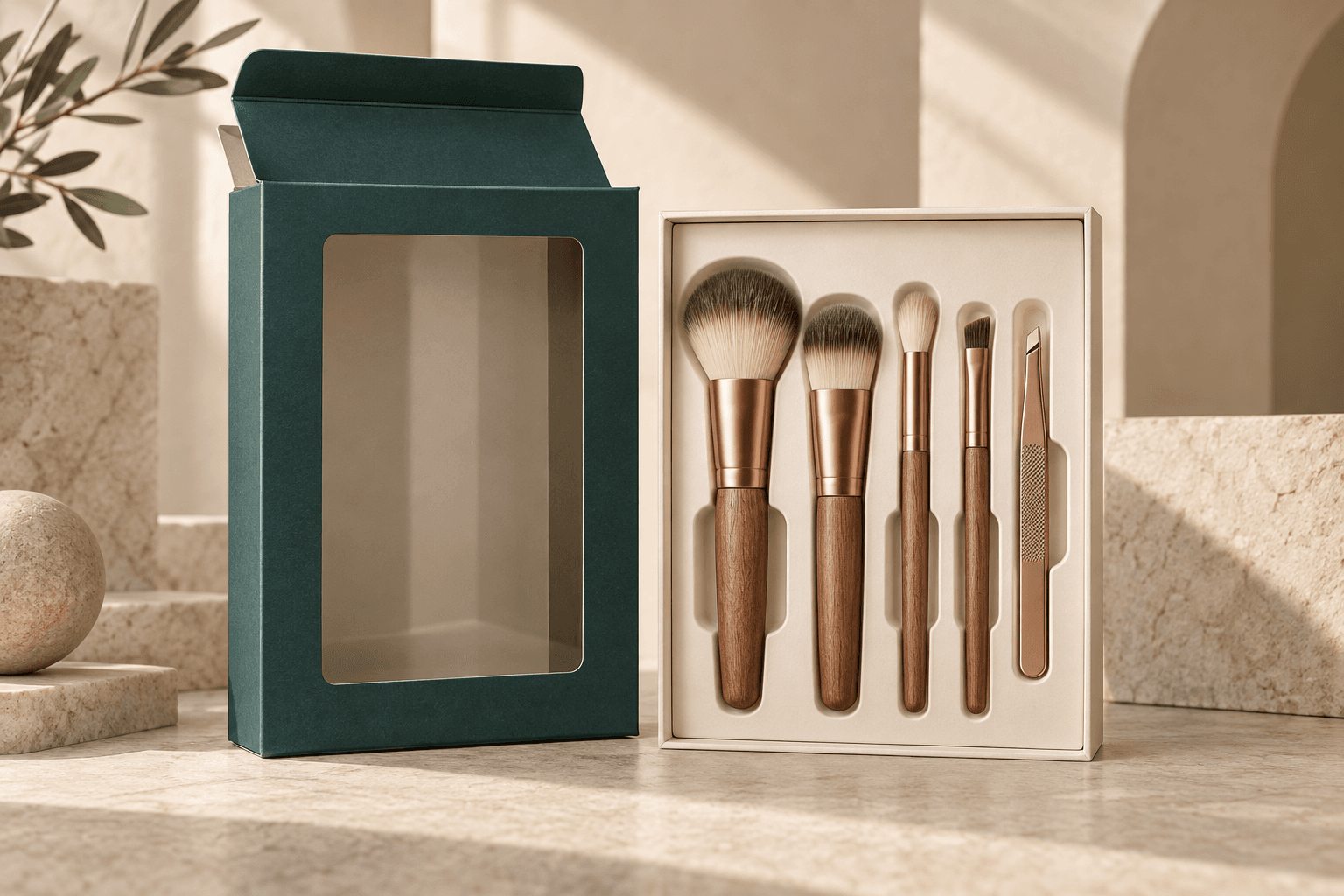
The right box structure for brushes and beauty tools depends on the complete item set, not the longest handle alone. Record maximum length, width and depth; identify delicate working ends, removable caps and mixed tool profiles; then decide whether the pack needs orientation, separation or simply a well-proportioned folding carton. Long narrow products can rotate or migrate inside a carton even when the overall dimensions look close, while multi-item sets can cross, rub or hide one another without planned positions.
This beauty tool packaging guide compares practical structures for a single brush, long handled tool and coordinated set. The goal is to connect each structural feature to a clear task: controlling position, protecting a sensitive end from contact, presenting the assortment or allowing easy removal.
Inventory every component before choosing a structure
List every item that will ship in the retail pack, including caps, sleeves, guards, instruction cards and accessories. Measure each tool in its final closed or guarded condition. For brushes, record the full length from handle end to the outermost bristle profile without compressing the bristles. For rollers, sponges, tweezers or applicators, identify the maximum operating head and any projecting joint.
Arrange the exact set in the intended order and photograph it with item names. A written list such as “five brushes” is not enough when ferrule widths, handle tapers and head shapes differ.
| Product condition | Structural question | Sample observation |
|---|---|---|
| One long brush | Can a slim carton limit rotation without contacting the bristles? | Check head, ferrule and handle-end contact separately |
| Mixed brush set | Do tools need individual locations or grouped retention? | Watch whether heads overlap after handling |
| Tool with cap or guard | Is the guard secure and included in maximum dimensions? | Confirm removal does not leave the guard behind |
| Metal or rigid implement | Could it rub another component or a viewing window? | Inspect finishes and edges after the review sequence |
| Brush plus sponge or accessory | Should different shapes occupy separate zones? | Check packing order and customer access |
Map sensitive zones, not just dimensions
Mark each tool as handle, transition or working end. A carton may contact the handle safely at selected points while contact at a brush head, sponge surface or precision tip is undesirable. Confirm acceptable contact surfaces with the product owner; do not assume every plastic or metal area can bear retention pressure.
For a brush, avoid designing a cavity by squeezing the bristle envelope. Compression can distort the presentation and may affect the tool. Keep the head clear unless a suitable guard is part of the approved product configuration. For a sharp or narrow implement, consider both product protection and whether the point could concentrate force against the carton.
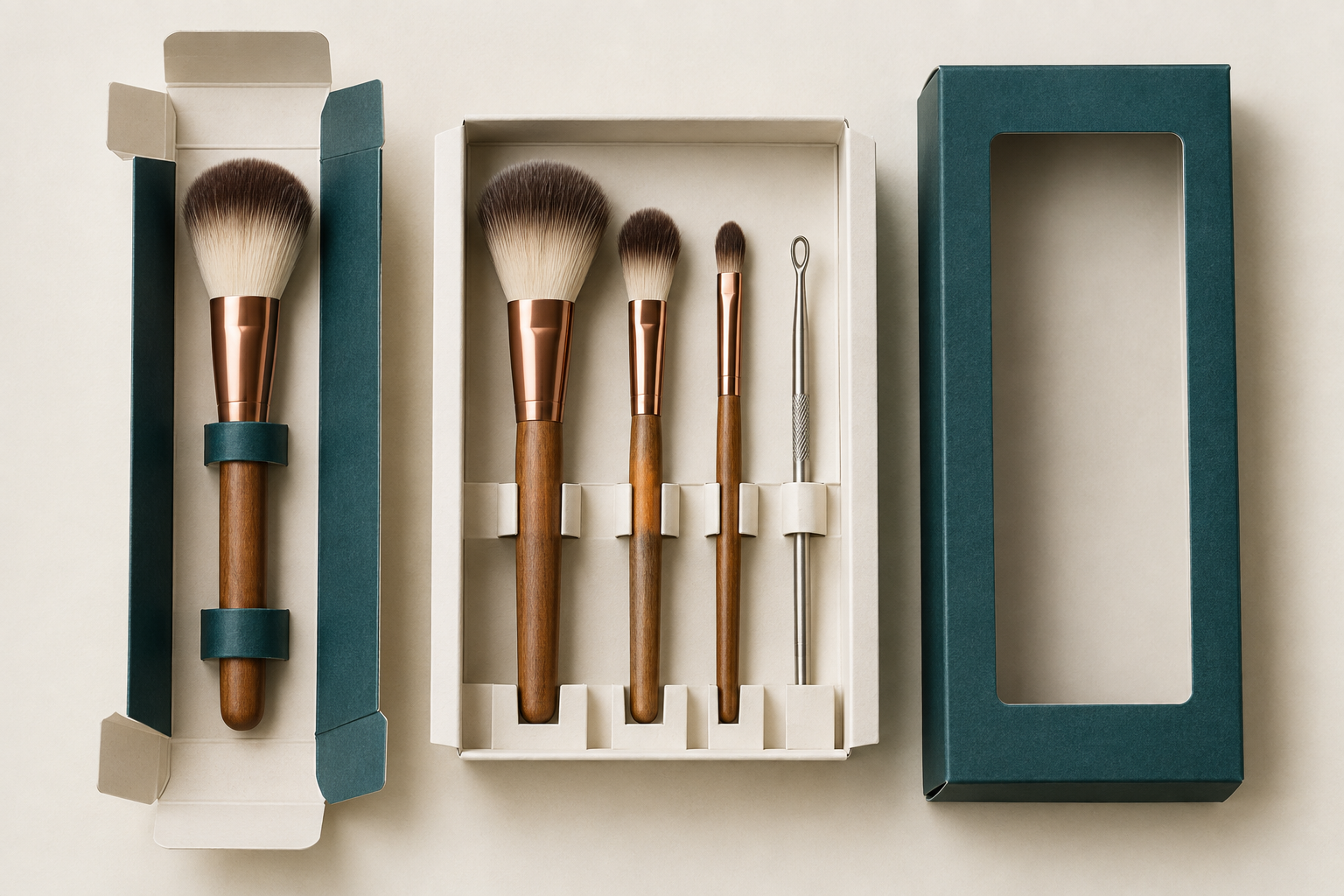
Choose among four practical structural directions
A narrow tuck-end carton can suit one stable tool when its ends and rotation are adequately controlled. A carton with folded paperboard locators can separate the handle and head zones or align several pieces. A tray-and-sleeve format can present an ordered set and create a deliberate reveal, but it adds parts and a sliding interaction that must be evaluated. A window carton can show the actual tools, provided the opening and any glazing do not undermine retention, copy space or structural performance.
Do not choose the most elaborate option by default. Begin with the simplest structure that could meet the brief, then compare alternatives using the same criteria: packing steps, position, contact, visibility, removal, material use and the required distribution evaluation.
Control a long tool at useful points
A long brush can pivot around a single narrow contact. Rather than tightening the entire carton, investigate two suitable locating zones—often near a robust handle area and away from the working end. The final geometry depends on the tool and should be proven in a sample.
Length also changes the behavior of carton panels. A slender box may bow, twist or expose more unsupported area than a short compact carton made from the same board. Board specification, grain direction, closures and packed weight should therefore be reviewed as a system rather than copied from a shorter package.
Cosmetic applicator formats vary significantly. HCP’s catalogue includes brushes and grooming tools integrated with primary packs, and an official mini mascara with brush groomer lists a 102-millimetre package height and a protected grooming feature. This example illustrates the need to measure the final assembly and guards; it does not establish dimensions for a separate makeup brush or indicate PearlFold supply.
Plan multi-item retention around the opening sequence
For a set, decide whether the customer should see all items at once or remove them in stages. Assign each tool a position and a grip area. A dense layout that photographs well may be frustrating if the first item cannot be lifted without pulling another by its bristles.
Check whether handles can cross or migrate into neighboring spaces. If one tool is shorter, avoid leaving an unrestricted channel simply because the longest tool sets the carton length. Localized folded features can control position without building a full-depth cavity around every item, but they must remain practical to erect and load.
Document the loading sequence. Similar-looking brushes can be placed in the wrong position unless the design or work instruction makes orientation clear. If a set has left and right positions, include an unambiguous assembly reference.
Use a window only when visibility has a job
A window can confirm tool count, color or head shape at shelf, but it also changes available panel area and creates edges near the product. State what the viewer needs to see and size the opening around that objective. A large opening that reveals only handles may add complexity without useful product information.
Review the relationship among cutout, optional window material, tool position and printed artwork. Ensure no working end presses against the window and no metal edge can scratch it. Consider how the pack appears when tools settle within permitted movement, not only when carefully arranged for a mockup photograph.
If a window is not necessary, a printed illustration or clear item list may communicate the set more consistently. Visibility is a merchandising choice, not a substitute for retention.
Test packing and removal with representative tools
Build structural blanks using the intended material and representative creases. Load final-intent tools, guards and collateral. Record time-consuming steps, accidental reversals and any contact with sensitive zones. Then ask an uninvolved reviewer to open the pack and remove each item in the intended order.
After the agreed handling sequence, inspect bristles, sponges, polished handles, printing, windows and carton closures. Define acceptance criteria before comparing samples. A pack that holds every item tightly is not successful if it marks the products or makes the set difficult to use.
Separate retail fit from distribution claims
Retail-carton fit work cannot by itself establish protective performance for shipment. Consider the complete packaged-product system, including any shipping case or e-commerce overpack. ISTA distinguishes screening and simulation test approaches; select an evaluation appropriate to the actual distribution channel and document what it does and does not show.
If the tool set, guard, carton structure, material or shipment configuration changes, review whether retesting is warranted. Keep the approved bill of materials and pack-out reference connected to the relevant evidence.
Explore custom beauty tool box options when you have the exact tool inventory and desired opening sequence. Include maximum dimensions, sensitive zones, orientation and visibility needs in a custom quote request so structure selection begins with the real set.
Beauty tool packaging questions
How do long brushes change carton design?
They create more opportunity for rotation and panel flex. Review useful locating points, closure behavior, board direction and the complete packed length instead of scaling up a short carton.
Should brush bristles touch an insert?
Do not use the bristles as a default retention surface. Identify approved contact zones, use any specified guard and confirm the sample does not compress or distort the working end.
When is a window box useful for beauty tools?
Use one when seeing the actual color, count or head type materially helps the buyer. Size and position it around that purpose while preserving retention and usable panel area.
Do multi-brush sets need individual cavities?
Not always. They need controlled positions appropriate to the brief. Grouped or localized paperboard retention may work, but compare movement, contact and removal with the actual assortment.
What dimensions matter for a makeup brush?
Record total uncompressed length, maximum head width and depth, ferrule profile, handle maximums and any guard. Mark which areas can accept contact.
Can several tool variants share one box?
Only after checking every variant’s geometry, weight, sensitive zones and identification. The largest length alone does not prove that smaller or wider tools fit correctly.
Is a tray-and-sleeve box better than a folding carton?
It offers a different reveal and retention opportunity, but also more parts and assembly. Choose from the brief and sample comparison rather than perceived prestige alone.
How should tools be arranged in a set?
Arrange them for clear presentation, repeatable loading and accessible removal while preventing unwanted overlap. Document item positions and loading order.
Does snug tool packaging prove transit protection?
No. Fit is one input. Protective claims require appropriate evaluation of the complete packed product in its intended distribution configuration.
What should accompany a beauty tool packaging enquiry?
Provide representative tools, a component list, dimensions, weights, guards, contact restrictions, preferred orientation, opening sequence, visibility objective and distribution context.