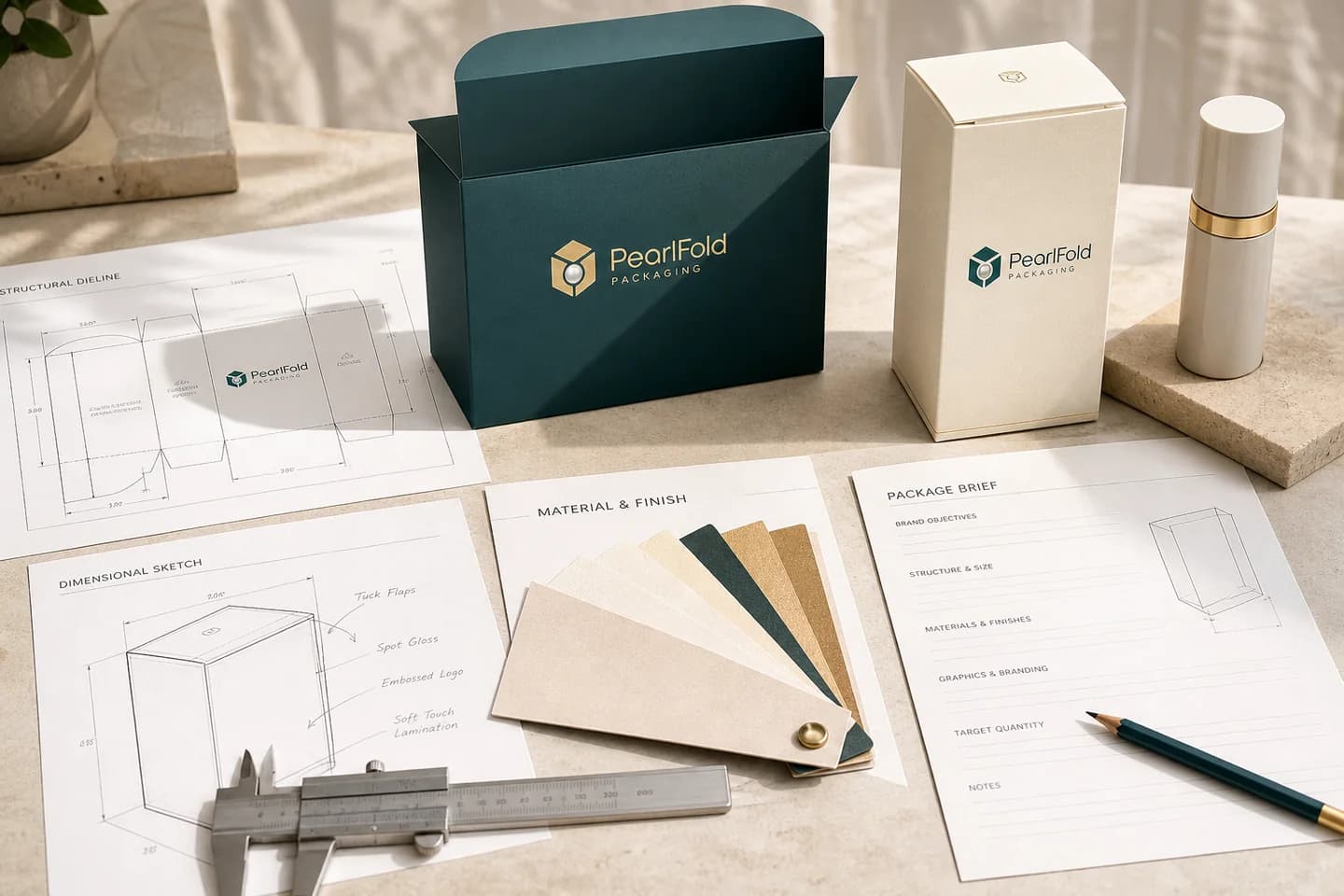


Build a beauty packaging launch plan by working backward from the date finished goods must be ready, then identifying the approvals that control that date: the product container, carton structure, artwork, proof or sample, written production scope and delivery plan. Give every decision an owner. Keep provisional information visible rather than treating a launch date as proof that the package is ready.
A launch plan is not the same as a packaging specification. The specification explains what will be made; the plan explains which decisions must happen first, who approves them and what happens when something changes. This guide focuses on that coordination. For the wider structural choices, use PearlFold’s custom packaging planning guide.
Define what “launch ready” actually means
Different teams can use the same launch date to mean different things. Marketing may mean the first campaign image. Procurement may mean cartons delivered to the filling partner. Sales may mean inventory available to retailers. Write these as separate milestones so photography approval is not mistaken for production approval.
Start with the required finished-goods availability date, the packing location and the distribution channel. Then ask the responsible partners for the activities and confirmed durations that precede it. Do not insert a generic production lead time from a website into the schedule. Sampling, revisions, material availability, order quantity and delivery arrangements need project-specific confirmation.
If the date cannot move, state which other variables can: the number of launch SKUs, a nonessential finish or the order sequence, for example. These are discussion options, not automatic solutions. Any change still needs a revised quote and approval where it affects the agreed scope.
Build your beauty packaging launch plan around dependencies
| Decision | Needed before | Evidence to retain |
|---|---|---|
| Finished container and closure | Final fit and insert approval | Controlled drawing and production-intent sample reference |
| Box structure and internal layout | Final production artwork | Approved dieline and structural review notes |
| Product copy and variant data | Artwork proof sign-off | Approved copy deck and SKU matrix |
| Material and decoration | Relevant color, finish and production approval | Named specification and agreed reference |
| Quantity and delivery scope | Order release | Accepted written quotation and delivery details |
These dependencies do not mean all work must happen sequentially. Copy drafting and reference gathering can often proceed while a container decision is being resolved. The important distinction is between work that can begin provisionally and a decision that can be approved finally. Mark that distinction directly in the plan.
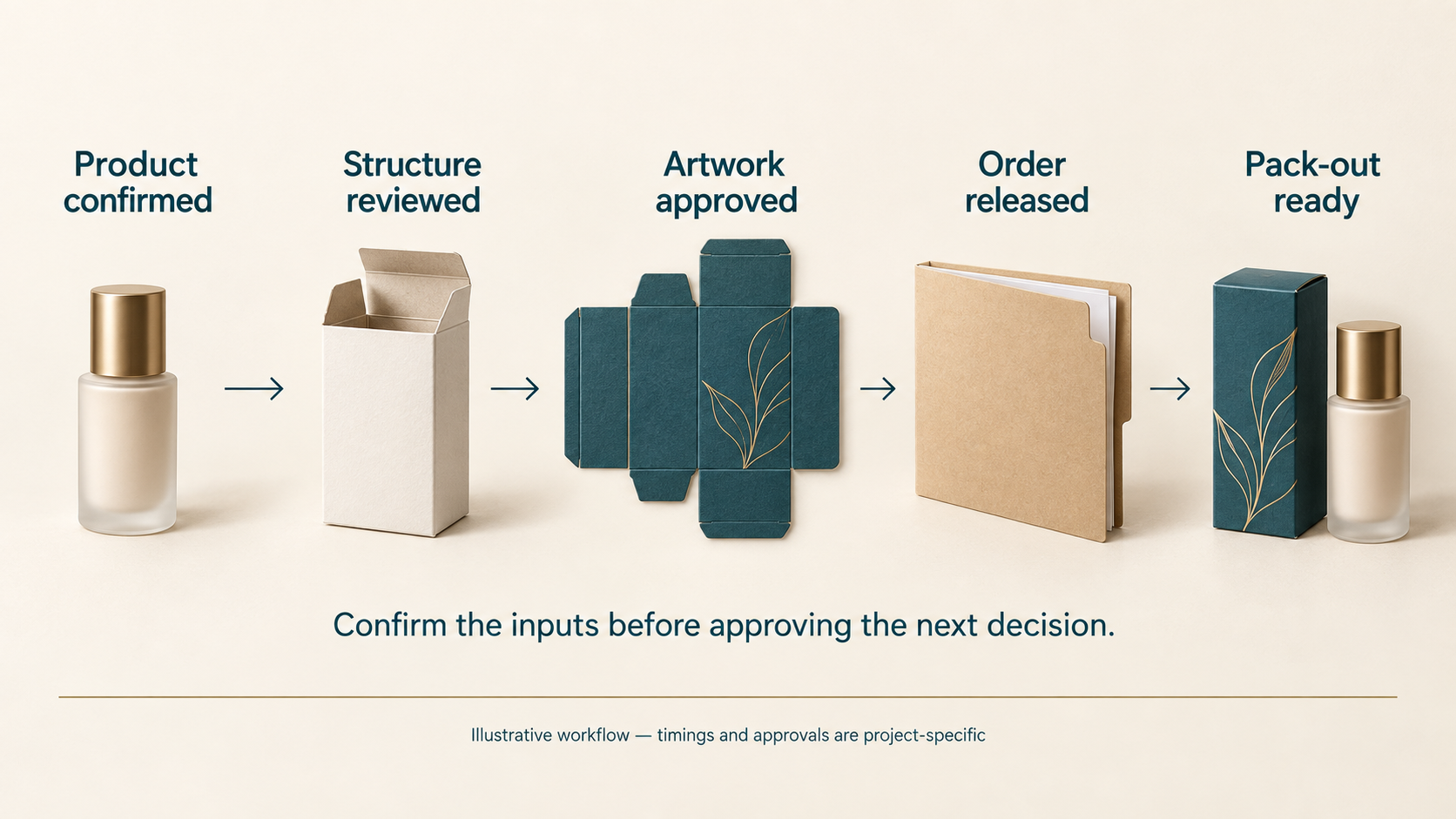
Separate locked inputs from open choices
Use three practical statuses: confirmed, provisional and unresolved. A confirmed input has an identified source and approver. A provisional input is usable for development but may change. An unresolved input has no dependable value yet. Each provisional or unresolved item should include its next action and owner.
For example, a bottle drawing may be confirmed while its decorative cap remains provisional. The packaging team can explore a visual direction, but the maximum product height is not locked. Recording that uncertainty prevents a concept rendering from becoming an accidental instruction to manufacture.
Keep preferences separate from requirements. “We prefer a matte surface” allows an informed discussion; “this specified coating is approved against sample A” is a production decision. Treating both statements as equally final creates avoidable disagreements when the quote or proof arrives.
Choose a lead SKU without ignoring the rest of the range
A representative SKU can help establish typography, panel hierarchy and the opening experience. Choose it because it reveals the range’s practical challenges, not simply because its artwork is finished first. A tiny carton with extensive supplied copy or an unusually wide closure may expose constraints that a larger, simpler package hides.
Build a SKU matrix before extending the design. Record each container, carton version, insert, product name, supplied net-content statement, barcode, artwork file and order quantity. Separate shared fields from variant fields. Review exceptional sizes early rather than forcing them into a dieline developed for a different product.
Illustrative planning scenario: a three-product launch includes a serum, a cream jar and a cleanser tube. The team can share a color system and typographic hierarchy, but each product has a different loading shape. One visual approval therefore does not approve all three structures. The schedule should contain three fit checks and one coordinated range review.
Agree what each proof or sample is supposed to demonstrate
A digital proof can help verify panel content and orientation. An unprinted structural sample can help reveal fit and opening problems. A decorated reference may answer a color or finish question. None should be assumed to prove every attribute of the final package.
Before requesting a sample, list the decisions it needs to support. Is the question whether a jar can be removed easily, whether a foil mark remains legible, or whether the assembled pack fits a shipper? Ask what the proposed reference represents and what it does not. Record any differences from intended production materials or processes.
This makes sample review purposeful. Use the samples and prototyping guide to prepare that discussion, with availability, charges and timing confirmed in the project quotation. Avoid scheduling an entire approval round around a sample type that has not been agreed.
Give content approval its own place in the schedule
Product copy, ingredient information, warnings, claims and market-specific labeling are supplied and approved by the brand’s qualified team. The packaging designer needs the approved content early enough to test its fit on the actual panels. Leaving this until the final proof can force changes to hierarchy, panel use or even carton dimensions.
Identify one person who consolidates comments. Conflicting instructions from marketing, regulatory, sales and procurement should be resolved before they become separate artwork revisions. A useful change note names the SKU, panel, current version, requested change and approving owner.
Do not equate an attractive mockup with a complete copy review. Check the actual production file at finished size, including less visible panels. Keep the broader packaging brief checklist as the specification companion; the launch plan should point to that information rather than reproduce several inconsistent copies.
Plan pack-out and delivery before approving the presentation
Clarify who erects the cartons, fits inserts, loads products and checks the packed units. Ask where empty packaging is stored and how it moves to the packing line or workstation. A presentation that looks simple on screen can involve an awkward assembly sequence when repeated across an order.
Also distinguish the retail box from the transport package. The launch plan should identify who approves the complete distribution configuration and any relevant testing. ISTA’s test procedure guidance explains that different evaluations serve different purposes; a visual sample is not a substitute for an appropriate transport review.
Confirm the receiving location, contact, delivery constraints and what constitutes an accepted delivery. Do not promise a delivery date to another team from an unconfirmed production estimate. Keep the commercial and logistics agreement linked to the same approved packaging version.
Use a change log instead of quietly moving the goalposts
After a decision is approved, any change should be recorded with its reason and affected items. A different cap may affect fit, dieline, artwork, insert and packing. A copy-only correction may have a narrower scope, but it still requires the correct proof version to be approved.
Ask the responsible partner to identify cost and schedule implications before accepting the change. Keep earlier approvals as history, not as active instructions. If a launch date is at risk, escalate the specific unresolved dependency rather than asking every team to “work faster” without a defined decision.
A short weekly review can focus on exceptions: what became confirmed, what changed, which decision is overdue and which downstream activity is now affected. The plan is useful when it reveals these constraints early, not when every row stays green regardless of evidence.
Launch-planning questions
When should packaging planning begin?
Begin while the product and channel are being defined, before final artwork is commissioned. Obtain project-specific timing from the partners responsible for samples, production, packing and delivery rather than assuming a standard number of weeks.
Can artwork begin before the bottle is finalized?
Visual exploration can begin, but identify it as provisional. Final panel artwork needs the confirmed structure. A later bottle or closure change can require a new dieline and another review.
Is a launch plan the same as a packaging brief?
No. The brief records requirements and specifications; the launch plan manages dependencies, dates, responsibilities and approvals. Link them so each team works from the same current facts.
Should every SKU use the same carton size?
Only if the actual products and required information support that choice. A coordinated appearance does not require identical dimensions. Separate structures can preserve the visual system while improving fit.
What should happen if required copy changes after proof approval?
Issue a controlled revision and repeat the affected checks before release. Identify whether it changes layout, finishing or structure, and obtain any revised commercial or timing agreement.
Can campaign photography use an early mockup?
It may be useful for internal planning, but distinguish a concept from the approved production package. Ensure customer-facing images and claims are accurate for the product being offered.
Who should approve the packaging?
Name the authorized owners for product data, supplied legal copy, artwork, structure and commercial release. One coordinator can consolidate their decisions without pretending to replace each specialist’s responsibility.
What if the launch deadline is fixed?
Identify the unresolved dependencies and ask for verified options. A change to finishes, SKU scope or order sequence may be considered, but each option needs a revised specification and realistic timing.
Does a sample approval mean the order has been released?
Not necessarily. Sample approval and commercial release are separate decisions. Confirm the quantity, final specification, quotation and authorized instruction required for the next stage.
What should be saved for the next production run?
Retain the approved files, product references, material and finish specification, review notes, SKU matrix and accepted commercial record. Document later substitutions rather than relying on “same as before.”
Make the next decision clear
A useful launch plan ends each discussion with a named decision, owner and required evidence. To discuss beauty and personal-care packaging, share the product details and launch constraints through PearlFold’s custom quote form. Identify which dates are fixed and which specifications remain open so the packaging discussion can start with the real dependencies.